Email templates in your theme
Overview of all email templates in Shoporama themes. Learn what each template does, when it's sent, and what variables you can use to customize your emails.
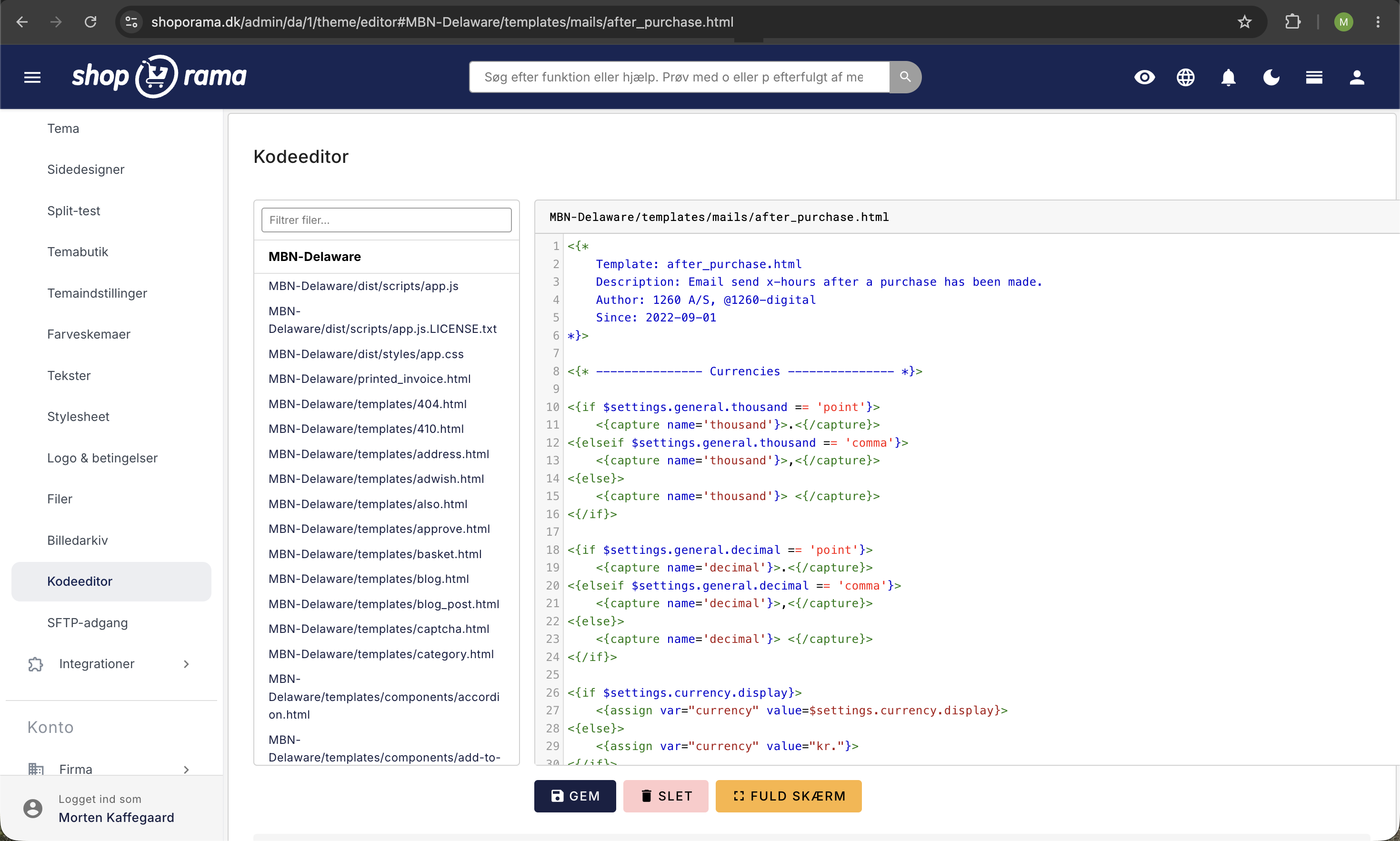
Shoporama themes include a number of email templates that control the automated emails your online store sends. All templates are located in the `templates/mails/` folder within your theme and use Smarty as the template language.
Shoporama’s standard Smarty 4 themes (Delaware, DelawareDK, Alaska2, California, Montana, Washington) provide email templates, but not all themes include all templates. If a template is missing from your theme, you can copy it from one of the other default themes.
Tip
You can customize the subject line and introductory text for most emails directly in the admin panel under Account → Webshop → General —without editing the templates.
Preview and Send a Test Email
Before editing your template, or to see how an email looks after your changes, you can preview and send test emails directly from the admin panel under Account → Webshop → Email Test.
- Select a template from the left column (e.g., invoice.html or basket_mail.html) to view the email with random test data in a preview
- Enter an email address and click Send Test Email to receive the email in your own inbox
- Reload the page to get new random data—such as a different order or a different customer—so you can verify that the layout remains consistent regardless of the content
If you want to translate or change the built-in text in the email, you’ll find it under Store → Design → Texts. Search the Mail section to find the strings that the template uses via {t section="Mail"}.
Order-related emails
| Template | When is it sent? | Key variables |
|---|---|---|
| invoice.html | Order confirmation — sent immediately after the customer has placed an order | $order, $webshop, $settings.company.* |
| order_sent.html | When the order status changes to "Shipped" — includes track & trace | $order, $order->getTrackingUrl() |
| order_ready_for_pickup.html | When the order is ready for pickup | $order, $pickup_name, $pickup_address |
| order_picked_up.html | When the order has been picked up | $order, $settings.company.* |
| order_credit.html | When a credit memo is created | $order, $order->getPublicUrl() |
| payment_mail.html | Payment link — when the order is pending payment | $order, $payment_url |
| return_label.html | When a return label is generated (PDF attached) | $order |
| return_received.html | When returned items are received | $order, $order_return |
| invoice_dropshipping.html | Sent to supplier for dropshipping orders | $order, $webshop |
Marketing emails
| Template | When is it sent? | Key variables |
|---|---|---|
| basket_mail.html | Abandoned cart email — sent automatically X hours after the customer abandons the cart | $basket, $basket_url |
| after_purchase.html | Follow-up email with product recommendations — sent X hours after purchase | $order, $webshop->getAfterPurchase($products) |
| product_review_mail.html | Request a product review — sent X hours after purchase | $order, $order->getPublicUrl('product_review') |
Inventory emails
| Template | When is it sent? | Key variables |
|---|---|---|
| in_stock_mail.html | When a sold-out product becomes available again (the customer has subscribed) | $product, $variant_name |
| out_of_stock_mail.html | When a product goes out of stock (sent to the store owner) | $product |
Customer emails
| Template | When is it sent? | Key variables |
|---|---|---|
| user-welcome-mail.html | When a new customer account is created | $customer, $customer->getTokenUrl() |
| user-reset-password-mail.html | When the customer requests a new password | $customer, $customer->getTokenUrl() |
| user-points-expires-mail.html | When the customer's loyalty points are about to expire | $customer, $points_to_expire, $points_expire_date |
Shared include files
The templates use shared includes for layout and reusable blocks:
- email.wrapper.start.html / email.wrapper.end.html — HTML wrapper with logo and footer
- email.order.details.html — Billing and shipping addresses
- email.order.products.html — Product list with images, SKUs, and prices
- email.order.recommendations.html — Product recommendations
- email.basket.products.html — Cart items for abandoned cart emails
- email.order.terms.html — Terms of Service and Privacy Policy
Customization without editing templates
Most emails can be customized directly in the admin panel under Account → Webstore → General:
- Subject Line — Customize the subject line for each email type
- Introductory text — Add custom text at the top of the email
- Logo — Set under Account → Webshop → General and used automatically in all emails
Global variables
These Smarty variables are available in all email templates:
$settings.company.name          Company name
$settings.company.phone         Phone number
$settings.company.email         Email
$settings.company.address       Address
$settings.company.zipcode       ZIP code
$settings.company.city          City
$settings.company.vat           Business registration number

$settings.currency.display      Currency symbol (e.g., "kr.")
$settings.general.thousand      Thousands separator
$settings.general.decimal       Decimal separator

$settings.theme.logo_url        URL to the company logo
$webshop->getName()             Name of the online store
$webshop->getUrl()              URL of the online store
Customization Tips
- Use UTM parameters in links in your emails so you can track performance in Google Analytics
- You can use Smarty logic for dynamic content—for example, display "Have a great weekend" on Fridays with {if $smarty.now|date_format:'%u' == 5}
- Always copy templates from a standard theme as a starting point—they already contain responsive HTML and all necessary variables
- Test your emails primarily via Account → Webshop → Email Test, where you can preview and send a test email with a single click. As a backup, you can always place a real test order and go through the entire process if you want to test the full interaction with the payment gateway and shipping provider
Frequently Asked Questions
How can I see what an email looks like without placing a real order?
Go to Account → Webshop → Email Test, select the desired template in the left column, and view the email directly in the preview. You can also send it to your own inbox to see how it looks in a real email program.
Can I translate the text in the emails without editing the template?
Yes. The built-in text is wrapped in {t section="Mail"} and can be translated under Store → Design → Texts in the Mail section. This is the recommended way to change the wording.
What test data is used when I preview an email?
Shoporama selects random data from your online store, such as an existing order or customer. If you reload the page, you’ll see a new random combination. This allows you to check whether the layout works regardless of the number of items, the length of product names, and so on.
Why aren’t my customers receiving a specific email?
The email is only sent if the template exists in your theme. If it’s missing, you can copy it from another default theme and place it in the `templates/mails/` folder of your own theme. Some emails also need to be enabled under Account → Webshop → General.
Do I still need to place a test order if I have Mailtest?
For daily checks and previews, Mail Test is the fastest option. If you want to test the full workflow—including the payment gateway, shipping setup, and status changes—you can place a real test order. The two methods complement each other.
Can I send a test email to a colleague or a customer?
Yes. Just enter the desired email address in the field. The test email feature has a reasonable rate limit, so it can’t be misused for mass mailings.
Do you need help customizing your email templates? Contact us at support@shoporama.dk.
Related articles
Change the content of your emails
Guide to customize the content of the automatic emails your Shoporama webshop sends, either via admin or theme templates.
Which templates are used for which emails?
Complete overview of all email templates in Shoporama - order confirmations, abandoned baskets, return labels, product reviews and much more.
Implement Theme Builder in your theme
Guide to implementing Shoporama's Theme Builder in your theme so the merchant can build pages visually.