Your online store is fast. Is your customer service?
An online store can be technically fast and still feel slow if the customer has to wait for a response. See how Shoporama data, customer channels, AI, and people can be brought together so that customer service becomes a driver of growth—not just a cost.
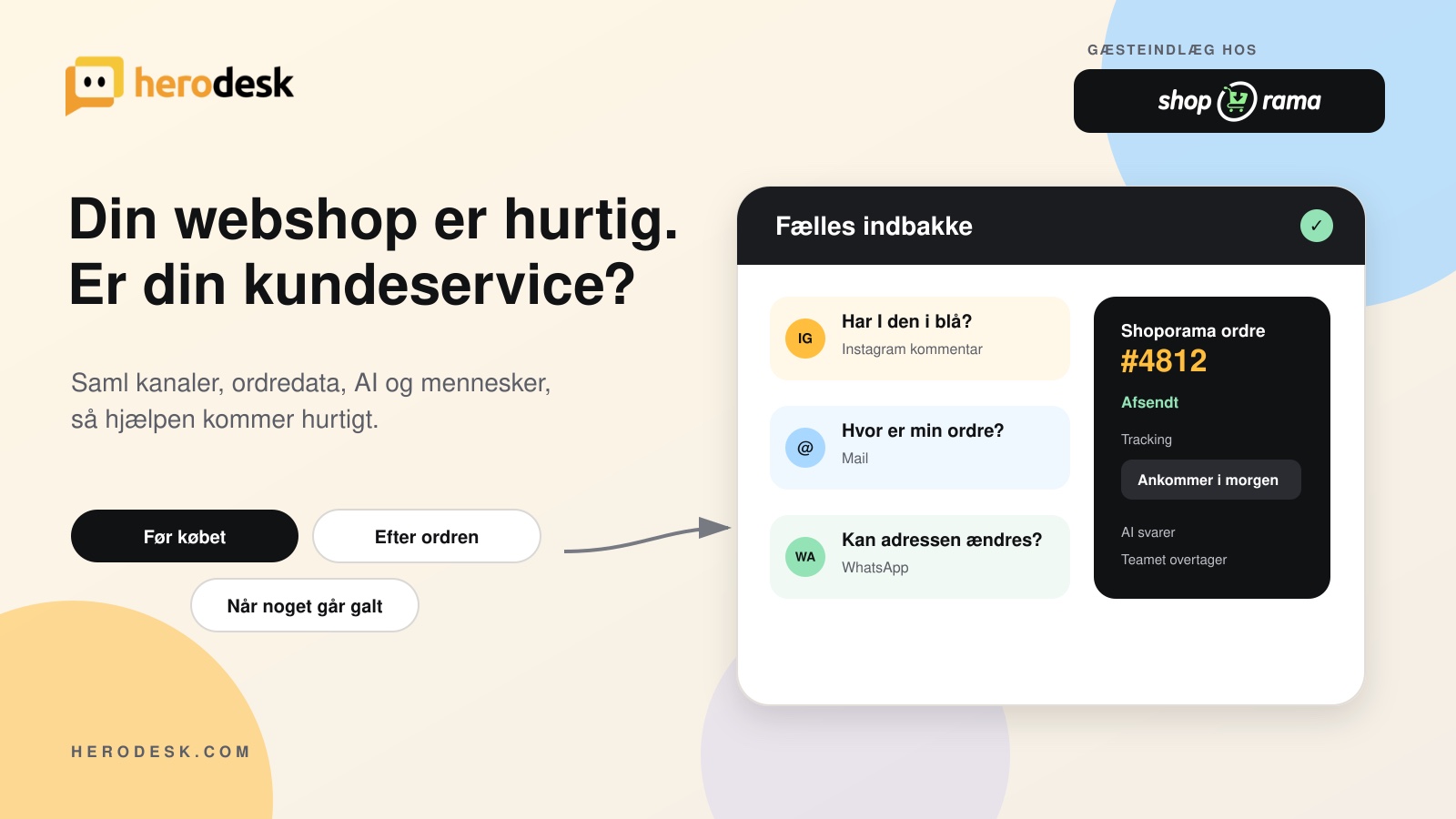
The customer doesn't see your systems. The customer just notices whether help comes quickly and whether you can keep up as orders increase.
By Jimmy Vejlemark, Commercial Director at Herodesk
Most online stores spend a lot of energy on speed. Pages need to load quickly, products need to be easy to find, and the payment process needs to go smoothly. That makes perfect sense, because no one wants to struggle through a purchase.
But from the customer’s perspective, the experience doesn’t end with the order confirmation. It continues when the customer asks on Instagram if the item is available in blue. When the shipping address needs to be changed. When the package seems to be stuck in transit. Or when a returned item still hasn’t been processed.
In these situations, a technically fast online store can suddenly feel very slow. Not because the site is slow, but because the response is.
That’s also why I believe customer service should be viewed as much more than just a cost. Customer service impacts sales, repeat purchases, loyalty, and the company’s reputation. At the same time, there’s a wealth of valuable insight in the conversations the team has with customers every single day—insight that sales, marketing, product, and management can all use to create value.
The customer sees one company
The customer doesn’t distinguish between your support email, live chat, Instagram profile, Facebook page, or phone line. To the customer, it’s the same company, no matter where the conversation begins.
Internally, things often look different. One colleague monitors email, another spots comments on social media, and the live chat has its own history. Meanwhile, the customer may have reached out in three different places and received two different responses.
Herodesk brings together email, live chat, Facebook, Instagram, WhatsApp, and phone calls into a single, unified inbox. Here, the team can assign conversations, write internal notes, and view the entire history if a colleague needs to take over.
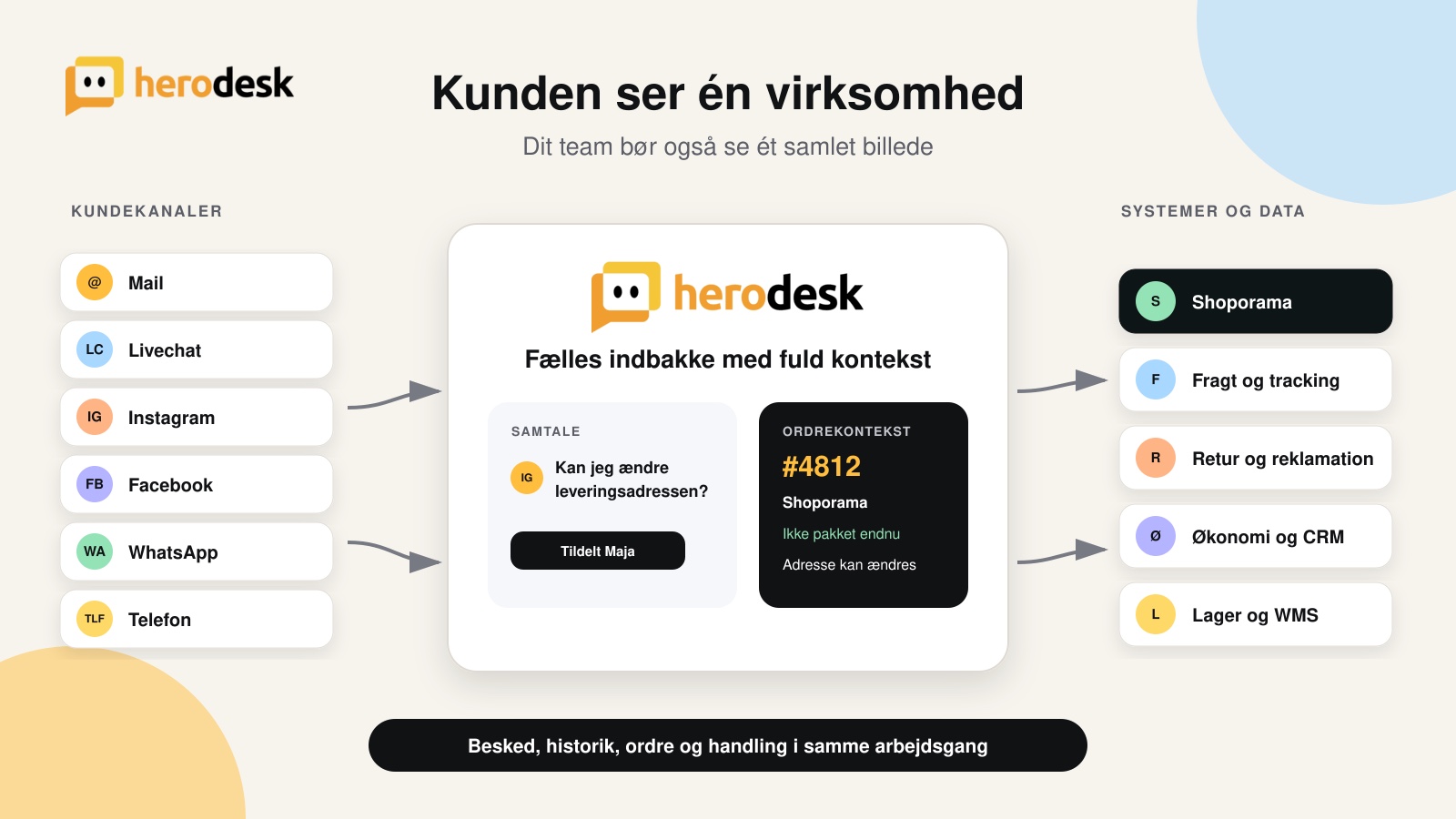
It may sound simple, but it makes a huge difference in day-to-day operations. The team knows who’s in charge, and the customer doesn’t have to start from scratch. This is especially important when multiple employees are assisting customers, or when the company operates across multiple brands and markets.
An unanswered question can cost a sale
Customer service often begins before the purchase. A customer might ask about inventory status, delivery, or fit in a comment. Another might message directly on Instagram because she’s ready to buy but needs just one more answer.
If these interactions are viewed solely as social media activity, inquiries can easily fall through the cracks between marketing and customer service. In Herodesk, comments and direct messages from Facebook and Instagram can be managed alongside all other conversations.
This makes it easier to respond quickly and see the issue through to the end. Because a fast and accurate response isn’t just good service—it can be the difference between a completed purchase and a customer who moves on to another online store.
When the order is right next to the conversation
Many inquiries are actually quite simple. Has the order been shipped? Where is the package? Can the address be changed? Has the return been received?
Delays often occur because the employee has to search for the answer—first in the online store, then in the shipping system, and perhaps afterward in a returns system. Each lookup doesn’t necessarily take a long time, but multiply that by hundreds of conversations, and it suddenly adds up to a lot of hours.
The direct integration between Shoporama and Herodesk displays Shoporama data right next to the customer’s chat. This allows the agent to view the order and type their response in the same place.
Herodesk can also be connected to systems for shipping, inventory, returns, finance, and CRM. With more than 30 integrations, the information the team uses most can be centralized around the customer conversation. This results in faster responses, less duplication of effort, and a much easier workday for both experienced and new team members.
More orders don’t automatically mean more staff
As an online store grows, the number of inquiries usually grows as well. But that doesn’t mean the customer service team necessarily has to grow at the same pace.
In fact, a large portion of the questions revolve around the same topics: delivery, inventory status, sizes, changes, returns, and complaints. Some require a human to handle them. Others do not.
A help center and an FAQ section can assist customers who prefer to find the answer on their own. Rules and automation can sort, prioritize, and route conversations to the right place. An AI agent can draft a response, answer selected routine questions, or perform specific actions. The team can then spend its time on the cases where rapport, judgment, and common sense actually make a difference.
The point isn’t to automate everything. The point is to eliminate the repetition and lookups that steal time away from meaningful customer interactions. This frees up capacity for more customers, more orders, and new markets, without requiring staffing levels to follow the exact same trajectory.
AI should improve service, not just make it cheaper
I’m certainly not against AI or automation. On the contrary. But it must never come at the expense of the customer or the company’s reputation.
Most people have, at some point, found themselves stuck in a loop with a bot that keeps giving the same response. That’s not effective customer service. It’s just a cheaper way to cause frustration.
An AI agent in Herodesk can use information from the specific conversation and the connected systems. For example, it can locate an order, retrieve tracking information, explain a return process, or perform a supported action when the rules allow it.
The company sets the limits itself. The AI can simply draft responses for an employee to approve. It can answer specific questions on its own and forward the rest. When a human takes over, the messages, order details, and a summary are included.
This is important because a customer receiving their third damaged shipment shouldn’t be met with yet another standard response. In this situation, a human must be able to take over immediately and understand the situation.
Customer service can stop a return before it happens
Good customer service isn’t just about response time. It can also trigger the right action while there’s still time to do something.
At Rito, Herodesk’s AI identifies inquiries from customers who want to change or cancel an order. The order is automatically put on hold before the warehouse ships it.
According to Rito’s customer case study, more than 4,500 orders have been paused in this way. This has saved the company 200,000 kr. in return processing costs.
This is a good example of how customer service doesn’t have to be a department that only reacts after a problem has arisen. When a customer’s message is linked to the right data and actions, customer service can both improve the customer experience and save the company from specific tasks and costs.
New Markets Without a Whole New Support Team
When an online store enters a new market, language quickly becomes a barrier. It’s difficult to provide good service if every response first has to be copied back and forth through a separate translation tool.
Herodesk offers two-way translation in 29 languages. The agent can read the message in their own language and reply right there. The customer receives the reply in their language, while the original message remains visible to the team.
This makes it possible to provide quality service in multiple markets before there’s enough volume to support a local customer service team in every country.
Bland Selv Frø is a great example. The company operates in 10 markets but has only one person in customer support. With Herodesk, customers can write in their local language, while the employee reads and responds in their own. The customer receives the response in their local language within the same conversation.
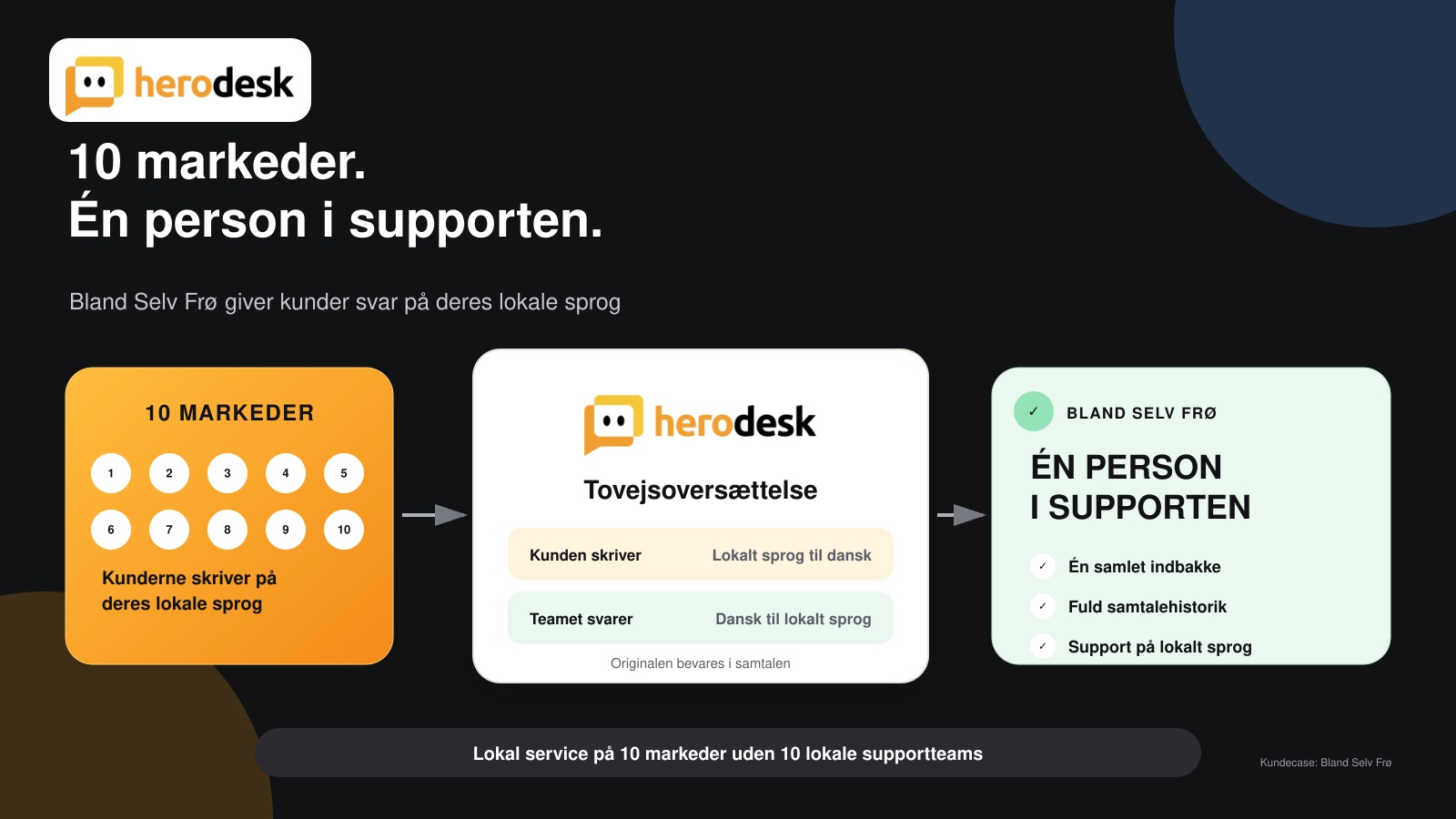
This means that Bland Selv Frø can provide local customer service across 10 markets without having to build a separate support team for each country. Here, translation becomes more than just a practical function. It becomes a concrete part of the company’s ability to grow internationally.
GDPR Must Be in Place from the Start
When you combine customer conversations, order history, and AI, data security must, of course, be in order. It must not be something you try to patch up afterward.
Herodesk is built in Denmark and hosted in the EU. Customer service data is hosted in Germany, while Herodesk’s AI runs on Herodesk’s own servers in Denmark. This means that conversations remain on European infrastructure, even when the AI is processing them. Herodesk is 100 percent GDPR compliant.
Start where it adds the most value
You don’t have to change everything at once. Start with the areas where customers wait the longest and where your team spends the most time.
- Bring together the channels your customers use, including email, chat, comments, and direct messages.
- Connect Shoporama to the systems that contain order, tracking, inventory, and return data.
- Identify the questions that come up every day and assess what a help center, automation, or AI can handle.
- Clearly define when a human should take over, and track response times, open conversations, and avoided returns.
Once the basic workflow is in place, you can integrate additional channels, markets, and automations. This way, the solution grows alongside your needs without making customer service unnecessarily cumbersome.
The Short Version
A fast online store isn’t just one with fast-loading pages and a smooth checkout process. It’s also fast when the customer needs help.
Herodesk brings together customer channels, Shoporama data, and more than 30 other integrations into a single workflow. AI and automation handle the repetitive tasks, while humans handle what requires understanding, judgment, and relationship-building.
That’s how customer service becomes a growth engine instead of just a cost. You can help customers faster, use the insights they provide, and make room for more orders without having to scale your team at the same pace.
You can explore the full Herodesk solution, create a free account, or try the Pro version for 14 days. All plans include free VIP onboarding with a product specialist.
Jimmy Vejlemark is the Chief Commercial Officer at Herodesk. He works to turn customer service into a growth engine by bringing together people, customer dialogue, systems, and AI into a single solution.
More from the blog
Reviews with photos: Let customers show the product as it is
Now your customers can attach photos when they leave a review of their purchase. A photo of the product in use at a real customer’s home shows...
19. oktober 2026
Inventory Value with Split Inventory: One Number for the Financial Statements, Without Duplicates
If your shops sell from the same inventory, each shop displays the full value of the shared inventory, and if you combine the shops, the items are...
17. oktober 2026
Customer Club Newsletter: Sell More to Returning Customers
Your regular customers are the ones most likely to make repeat purchases. Now you can send the newsletter only to the customer club, to a specific...
14. oktober 2026