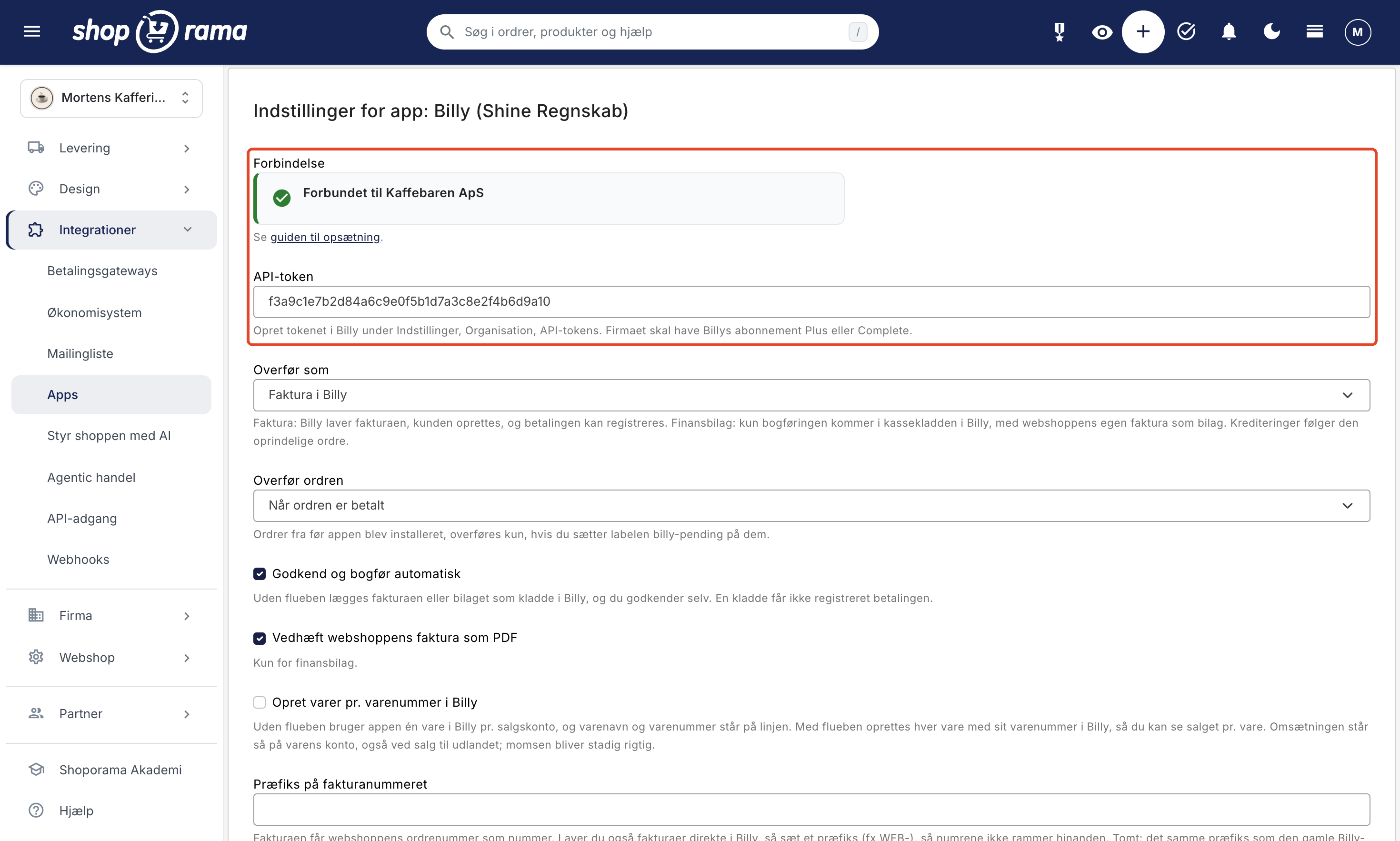
The Billy integration is a free app in Shoporama that transfers your orders and credits to Billy. Billy is now called Shine Regnskab, and in Shoporama you’ll find the app listed as Billy (Shine Regnskab) under Integrations, Apps. By default, an order becomes an invoice in Billy, and for paid orders, the payment is recorded so that the invoice is marked as paid. You connect the app using an API token that you create yourself in Billy. Your company must have Billy’s Plus or Complete subscription.
Here’s what you get from the app
- No manual data entry. The customer, product lines, shipping, discounts, and sales tax are automatically transferred to Billy once the order is paid or shipped. You don’t need to copy amounts from the online store to your accounting system.
- Correct VAT on every line item. Danish VAT, VAT-exempt items, sales to businesses in other EU countries with a valid VAT number, and exports outside the EU each have their own VAT rate in Billy. If an order contains items with different VAT rates, the discount is distributed based on the value of the items.
- Verification before posting. The invoice is first created as a draft, and the amounts and VAT are compared with the order. If they match, the invoice is approved when “Approve and Post Automatically” is enabled. If they differ, it remains as a draft, and the note on the order explains why.
- Credit memos linked to the invoice. If you issue a credit for an order in Shoporama, it becomes a credit memo in Billy that is linked to the original invoice and to the same customer. If the app recorded the payment on the invoice, the refund is posted to the same account.
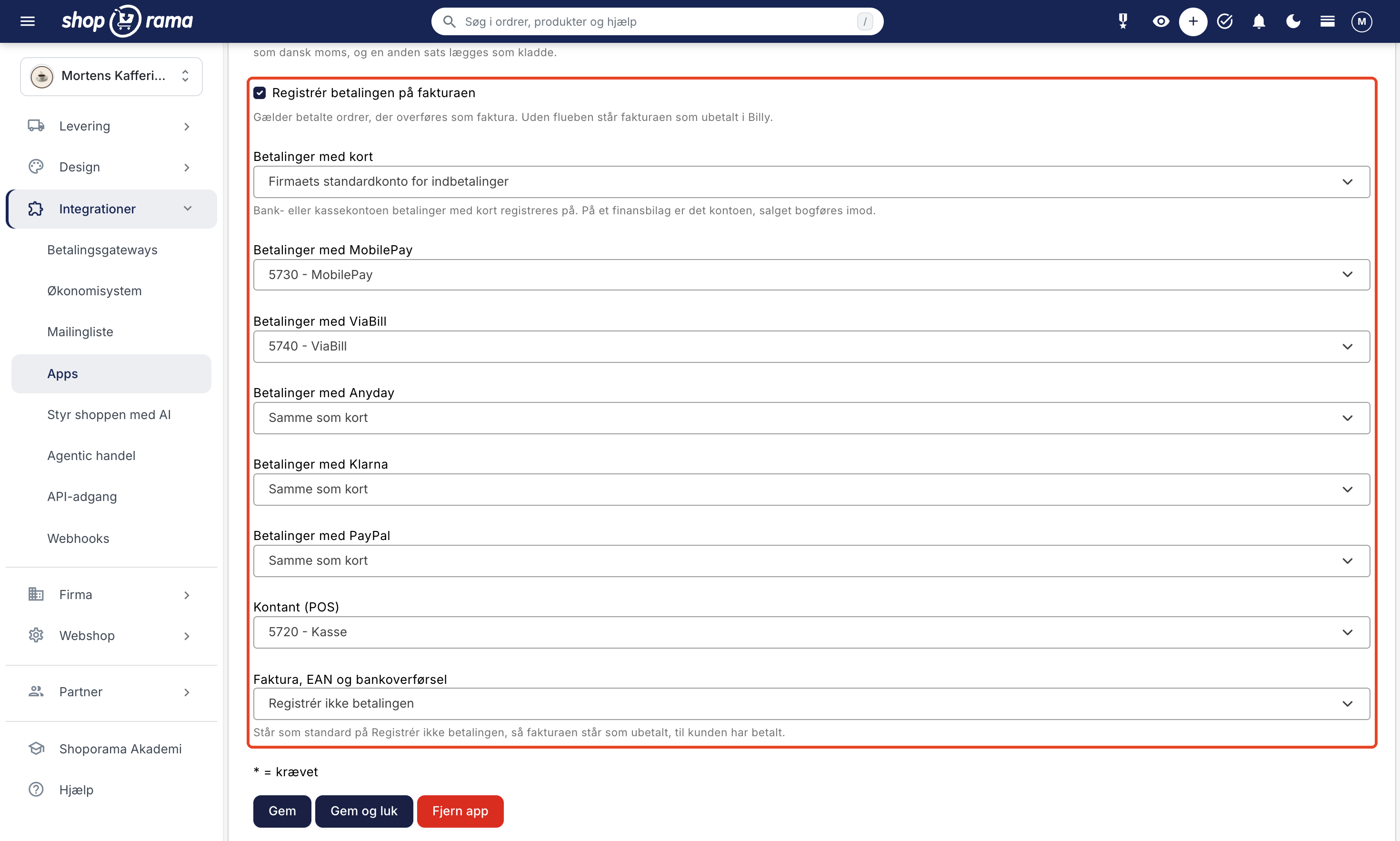
- Payment to the correct account. Card, MobilePay, ViaBill, Anyday, Klarna, PayPal, and in-store cash payments can each be assigned their own account in Billy. Orders paid by invoice, with an EAN number, or by bank transfer are marked as unpaid by default until the customer has paid.
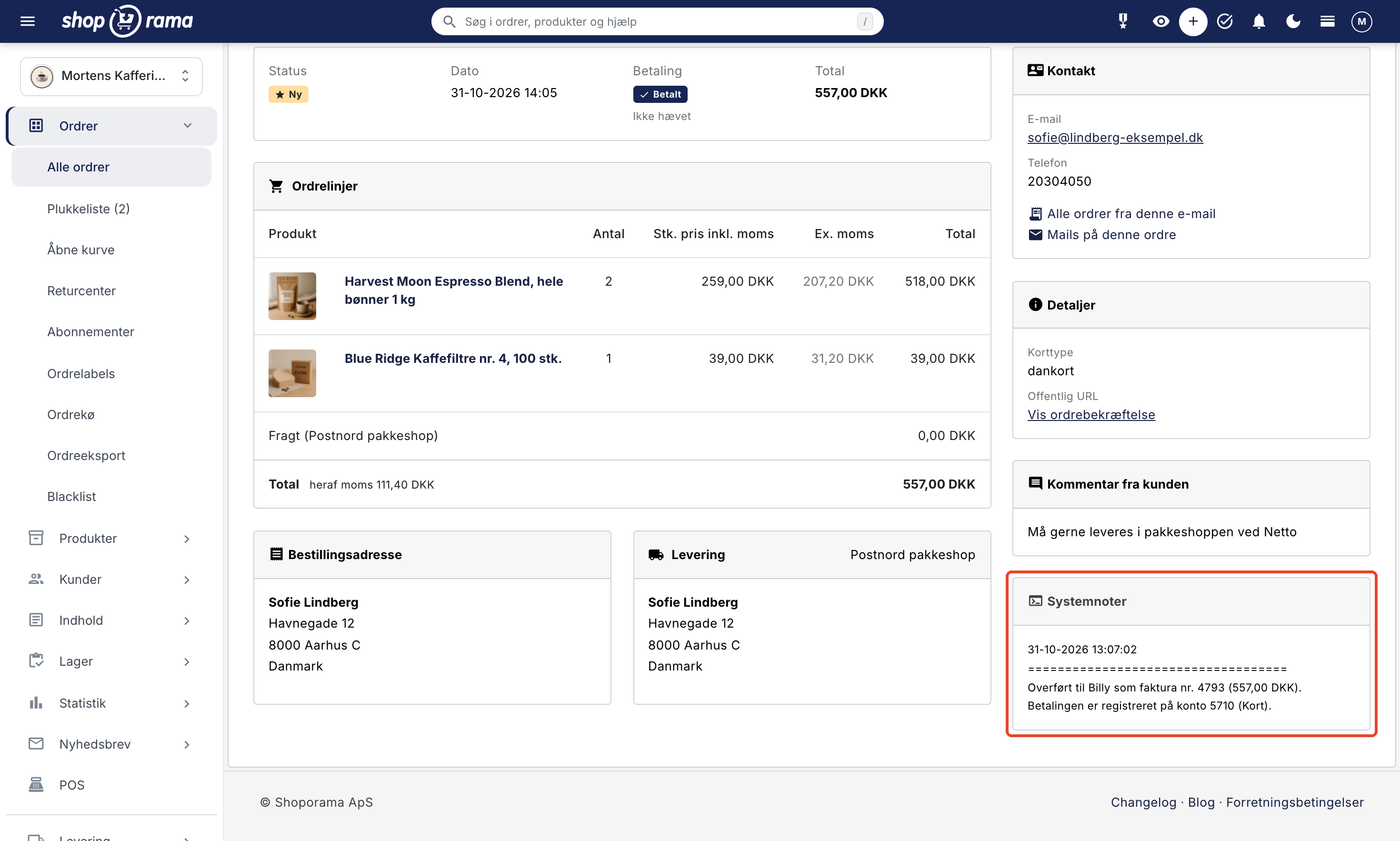
- Errors are displayed on the order. A successfully processed order receives the green “billy-ok” label and a note with the invoice number. If something goes wrong, the order receives the red “billy-failed” label with an explanation, and the app’s settings show how many orders have failed in the last 7 days.
- Customers are recognized. The customer is identified in Billy by email, so the same customer isn’t created again on their next purchase. Businesses are associated with a CVR number, EAN number, and contact person. If you’d rather group private customers under a single customer in Billy, you can choose that option.
- Free. The app is free in Shoporama. With Billy, the company must have a subscription that includes access to the API—that is, the Plus or Complete plan.
Here’s how it works
Install the app under Integrations, Apps; create an API token in Billy under Settings, Organization; and enter it into the app. Once the token is saved, the “Connection” field shows which company in the Billy online store is connected to, and the lists of accounts are retrieved from the company’s chart of accounts in Billy.
- Invoice or financial document. By default, Billy creates the invoice and adds the customer. If you choose a financial document, only the journal entry appears in Billy’s cash book, with the online store’s own invoice attached as a PDF. Credit memos follow the original order.
- One transfer per order. The order is transferred once it has been paid or shipped—whichever you choose—and only once. Canceled orders are not transferred. Orders placed before the app was installed are included if you apply the “billy-pending” label to them.
- Invoice number and order number. The invoice is assigned the online store’s order number. If you also create invoices directly in Billy, you can add a prefix such as “WEB-” to the front so the numbers don’t overlap. If you check the box, the cart number will appear after the invoice number—for example, 4792:5402—so you can see it when you reconcile your bank statements. The online store’s order number or cart number also appears as the order number on the invoice.
- Items in Billy. In Billy, the item determines which account the sale is posted to. The app therefore automatically creates one item per sales account, and the item name and item number appear on the invoice line. You do not need to create items for shipping and discounts. If you want to view sales by item in Billy, the app can instead create each item with its own item number.
- Currency. If you sell in multiple countries, each with its own currency, the invoice will be in the order’s currency using the exchange rate at the time of purchase, not Billy’s daily rate. A financial document is in Danish kroner, converted using the same exchange rate.
- OSS. Billy does not have VAT rates for OSS. If you are registered for OSS, check the box for “Registered for OSS (VAT in the buyer’s EU country).” All orders with VAT for private customers in other EU countries will then be created as drafts with Danish VAT; the order will be labeled “billy-failed” and include a note, and you’ll correct the VAT in Billy and approve it there. If the checkbox is not selected, 25% will be posted as Danish VAT, and only orders with a different rate—such as German VAT—will be added as drafts.
The app does not do this
- It does not sync inventory or prices. The app only sends orders and credit memos to Billy.
- It does not retrieve any data from Billy. If you correct or record anything in Billy, it will not be transferred to Shoporama.
- It does not reconcile payments and fees from payment providers.
- It cannot include the order number on the payment itself in Billy. Use the invoice number, optionally followed by the cart number, when reconciling.
- It does not send the invoice from Billy to the customer. The app does not send any emails.
- It does not update the invoice if you edit the order in Shoporama afterward.
- It does not automatically retry when a transfer fails. You must correct the error and apply the “billy-pending” label to the order.
If you’re using the built-in Billy integration under Integrations, Accounting System, install the app, set it up, and then set Supplier to None under Accounting System. Until then, the app won’t transfer any orders so they aren’t imported into Billy twice. The old integration will transfer them as usual, and the app will apply the “billy-failed” label with a note to them. Afterward, check the orders from that period in Billy, and only apply the “billy-pending” label to orders that are missing in Billy. The settings aren’t transferred automatically, so enter the token and select the accounts in the app.
Invoices created by the old integration can still be credited using the app. The credit memo is linked to the original invoice, which the app finds in Billy based on the invoice number.
How to set it up: the guide for the Billy app. If you’d like to learn more about what a Billy online store offers, read “Online Store with Billy,” or view all accounting integrations under “Accounting Software.”