Billy Integration: Transfer Orders to Billy (Shine Accounting)
Here's how to install the free Billy app, connect it to an API token from Billy (Shine Accounting), select sales and payment accounts, and have orders from your online store imported as invoices or financial documents.
With the Billy app, orders and credits from your online store are automatically imported into Billy, either as invoices or as financial documents with the online store’s own invoice as a PDF. Billy is now called Shine Regnskab, but the program works just as before, and in Shoporama you’ll find the app under the name Billy (Shine Regnskab). Sales tax, shipping, discounts, and payments are posted to the accounts you select, and if something goes wrong, you can see it directly on the order in Shoporama. The app is free and developed by Shoporama.
What You’ll Need
- Billy with the Plus or Complete subscription. Billy’s API, which the app uses, is only available with those two subscriptions.
- Access to your company in Billy so you can create an API token for Shoporama.
- A user with full access in Shoporama. Only that user can install apps.
Are you using the old Billy integration?
If you’ve set up Billy under Integrations → Accounting System, set up the app as described below, and then read Switch from the old Billy integration. The app won’t transfer any orders until you’ve disabled the old one.
Step 1: Install the app
- Go to Integrations → Apps.
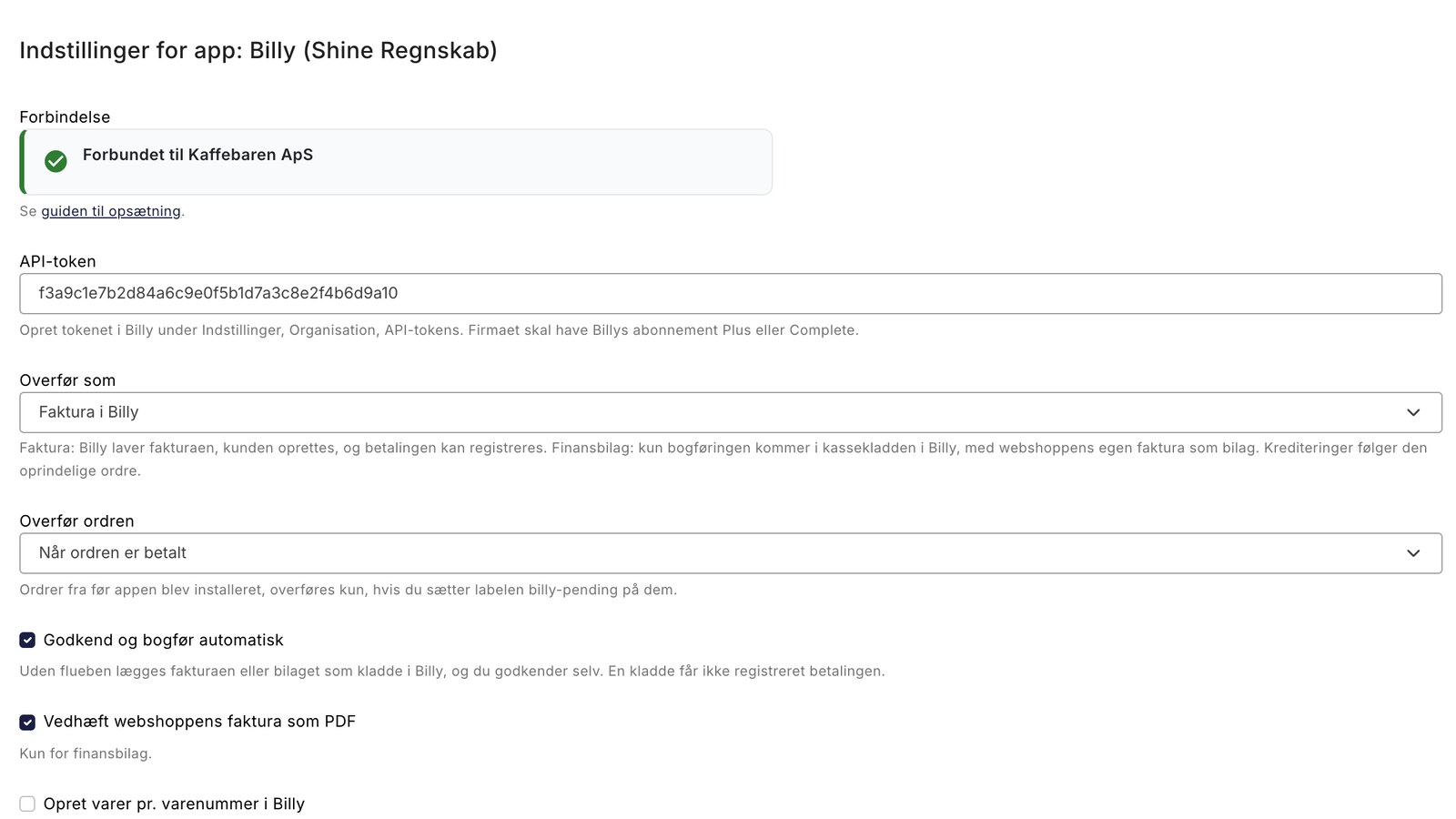
- Find Billy (Shine Accounting) and click Install. The App Settings: Billy (Shine Accounting) page opens. Later, you can find it by clicking the Settings button on the card under Installed Apps.
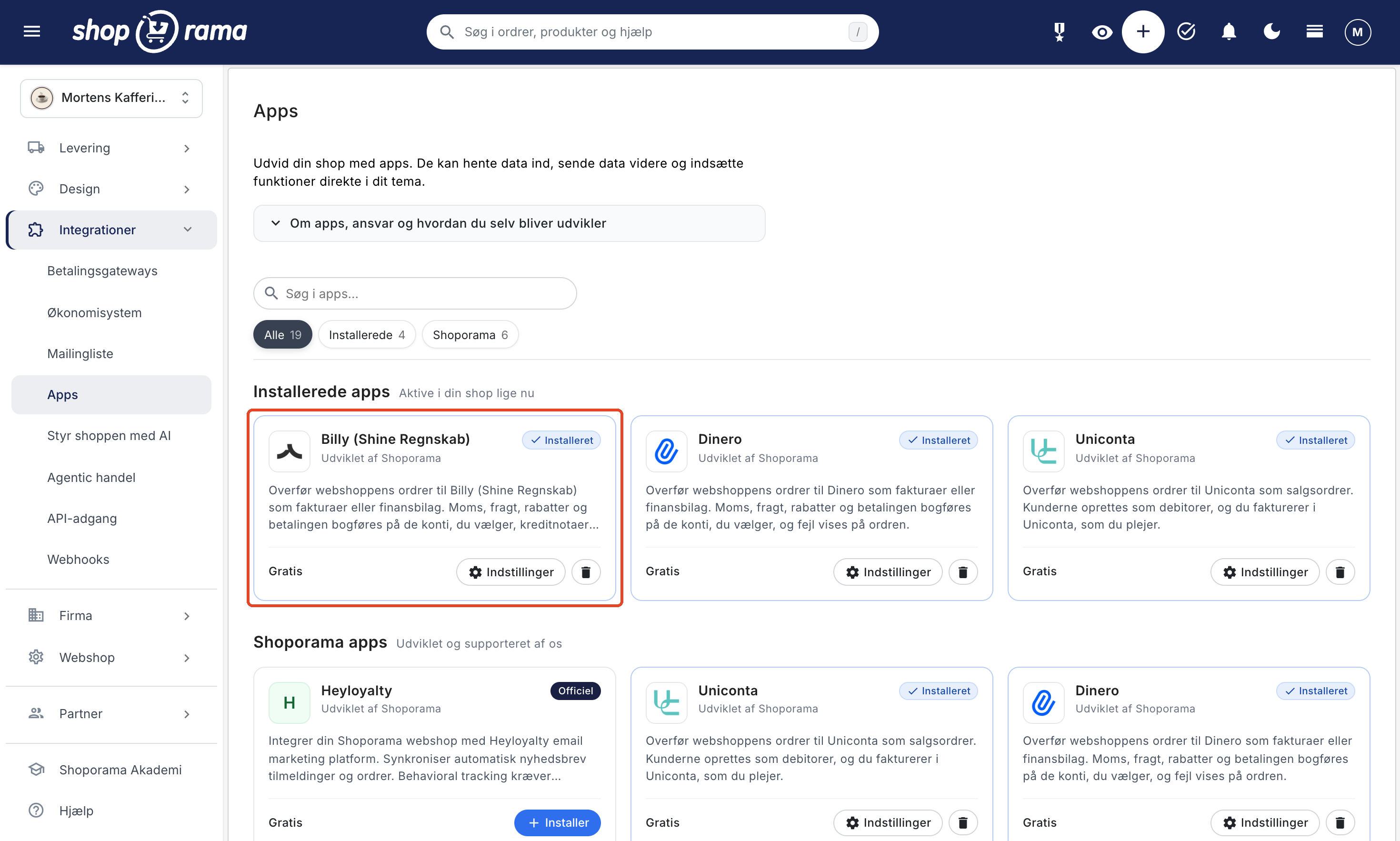
Once the app is installed, it creates three order labels in your store: billy-ok, billy-pending, and billy-failed. You’ll use these to track the data transfer, as described below.
Step 2: Create an API token in Billy
The app accesses your accounting data using an API token that you create yourself in Billy. You do not need to log in with your Billy account in Shoporama. The token is associated with your company in Billy and does not expire.
- Log in to Billy and go to Settings.
- Find API tokens under Organization. Shine Accounting’s own help section also refers to them as access keys.
- Create a new token, name it Shoporama, and copy it.
The token grants access to your accounting data, so do not share it with others.
Step 3: Paste the token and save
- Paste the token into the API Token field in the app’s settings.
- Click Save.
At the top of the page is the Connection field. Before you’ve pasted the token, it says Not connected to Billy. Once the token is saved, it says Connected to followed by the name of the company in Billy. If the company is in a trial period, it also says The company is in a trial period in Billy.
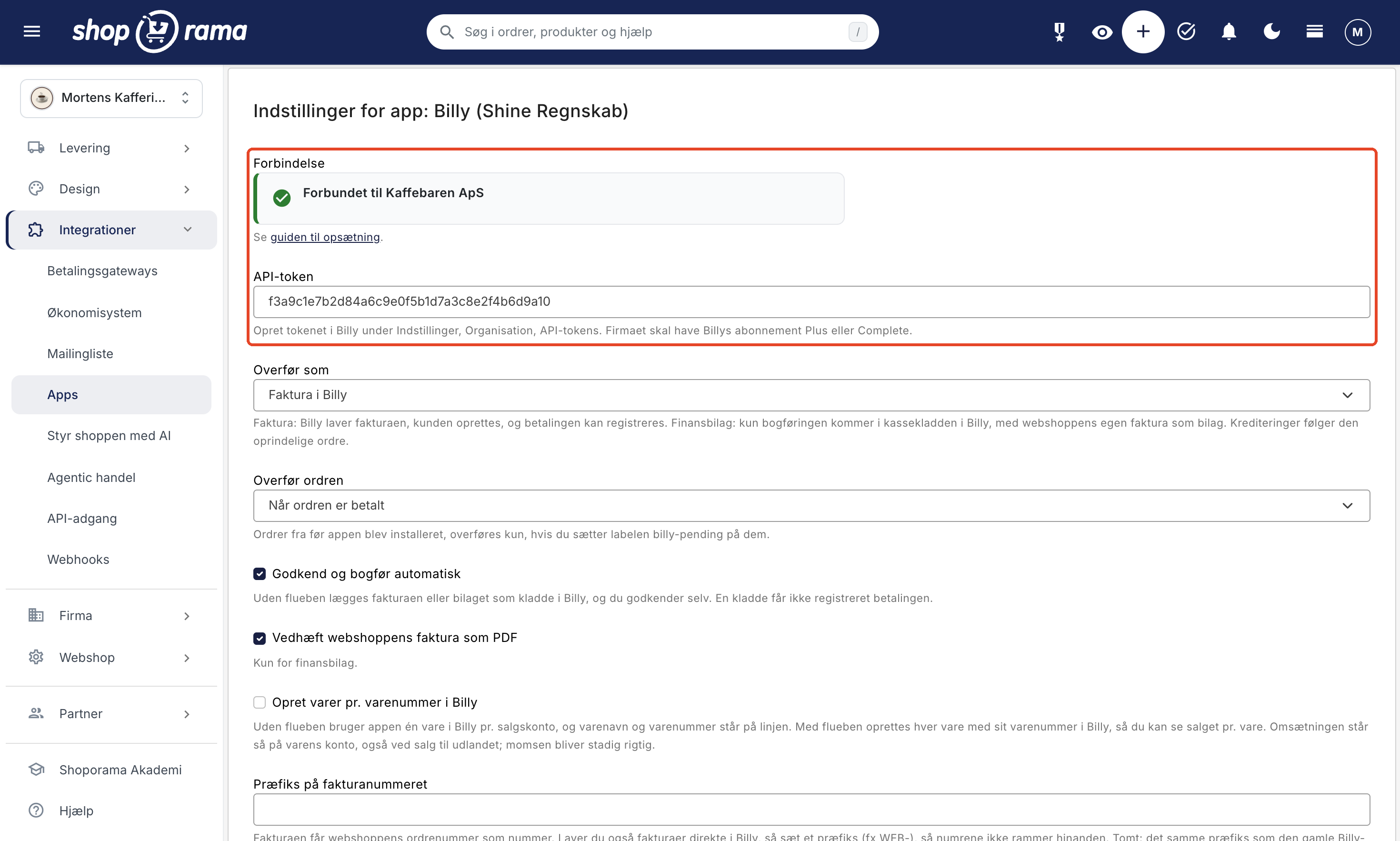
Only after the token is saved can the app retrieve the chart of accounts from Billy. Until then, the account lists show only the default accounts with the text “Enter the API token and save to view the chart of accounts.”
Step 4: Choose how and when the order is transferred
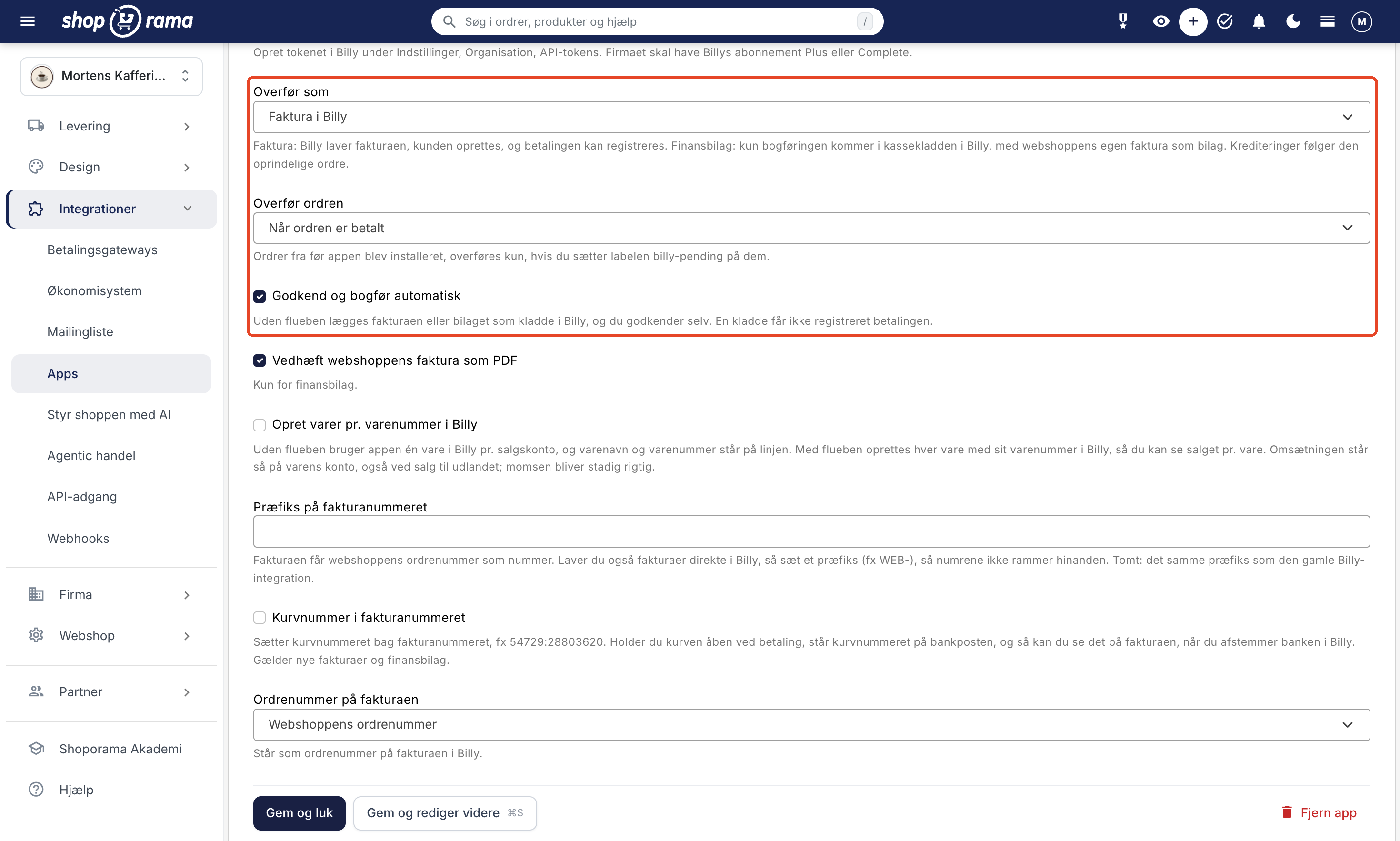
- Transfer as: Invoice in Billy (default) or Financial Document with the online store’s invoice. The difference is explained under “Invoice or Financial Document? ” below.
- Transfer the order: When the order is paid (default) or When the order is shipped. With “When the order is shipped,” only orders with the “Shipped” status are transferred. If you offer in-store pickup, select “When the order is paid.” The transfer occurs automatically shortly afterward. Orders from before you installed the app are only transferred if you apply the “billy-pending” label to them.
- Automatically approve and post: enabled by default, so the invoice is approved and the financial document is posted immediately. If you uncheck this box, the invoice or document is saved as a draft in Billy, and you approve it yourself. A draft does not record the payment.
- Attach the online store’s invoice as a PDF: enabled by default. Applies only to financial documents.
Invoice number, customers, and items
- Invoice number prefix: The invoice is assigned the online store’s order number, e.g., 4792. With the prefix “WEB-,” it becomes “WEB-4792.” If you also create invoices directly in Billy, set a prefix to prevent number conflicts. If you leave the field blank, the app will use the prefix you had in the old Billy integration, if you used it.
- Cart number in the invoice number: disabled by default. If you check the box, the app adds the cart number after the invoice number, e.g., 4792:5402. If you keep the cart open until the order is paid (open cart), that’s the cart number the payment provider receives, and it’s typically the number you see on your bank statement. Then you’ll see the same number on the invoice when you reconcile your bank in Billy. Without an open cart, the payment provider receives the order number, so you typically don’t need to check the box. This applies to new invoices and financial documents. Orders without a cart number—such as credits and exchange orders—receive only the order number.
- Order number on the invoice: The online store’s order number (default) or Cart number (as provided by the payment provider). This number appears as the order number on the invoice in Billy. If you want to see the cart number when reconciling your bank statements, use “Cart Number” in the invoice number field instead, because Billy displays the invoice number in the reconciliation suggestions.
- Customers in Billy: Create each customer (identified by email) (default) or Group private customers under a single customer (online store customers). Businesses are always created as separate customers with a CVR number and a contact person.
- Create items by item number in Billy: disabled by default. Without a checkmark, the app uses one item in Billy per sales account, and the item name and item number appear in the text on the line. With the checkbox selected, each item is created with its own item number in Billy, so you can view sales by item. Revenue is then posted to the item’s account, even for international sales, but the sales tax is still calculated correctly. Items created by the old integration are reused when the item number is the same. Items without an item number, shipping, and discounts still use one item per account.
Step 5: Select Sales Accounts
The lists show the revenue accounts from the company’s chart of accounts in Billy, along with their numbers and names. The default accounts 1110, 1140, and 1120 are from Billy’s default chart of accounts. Their names depend on your chart of accounts.
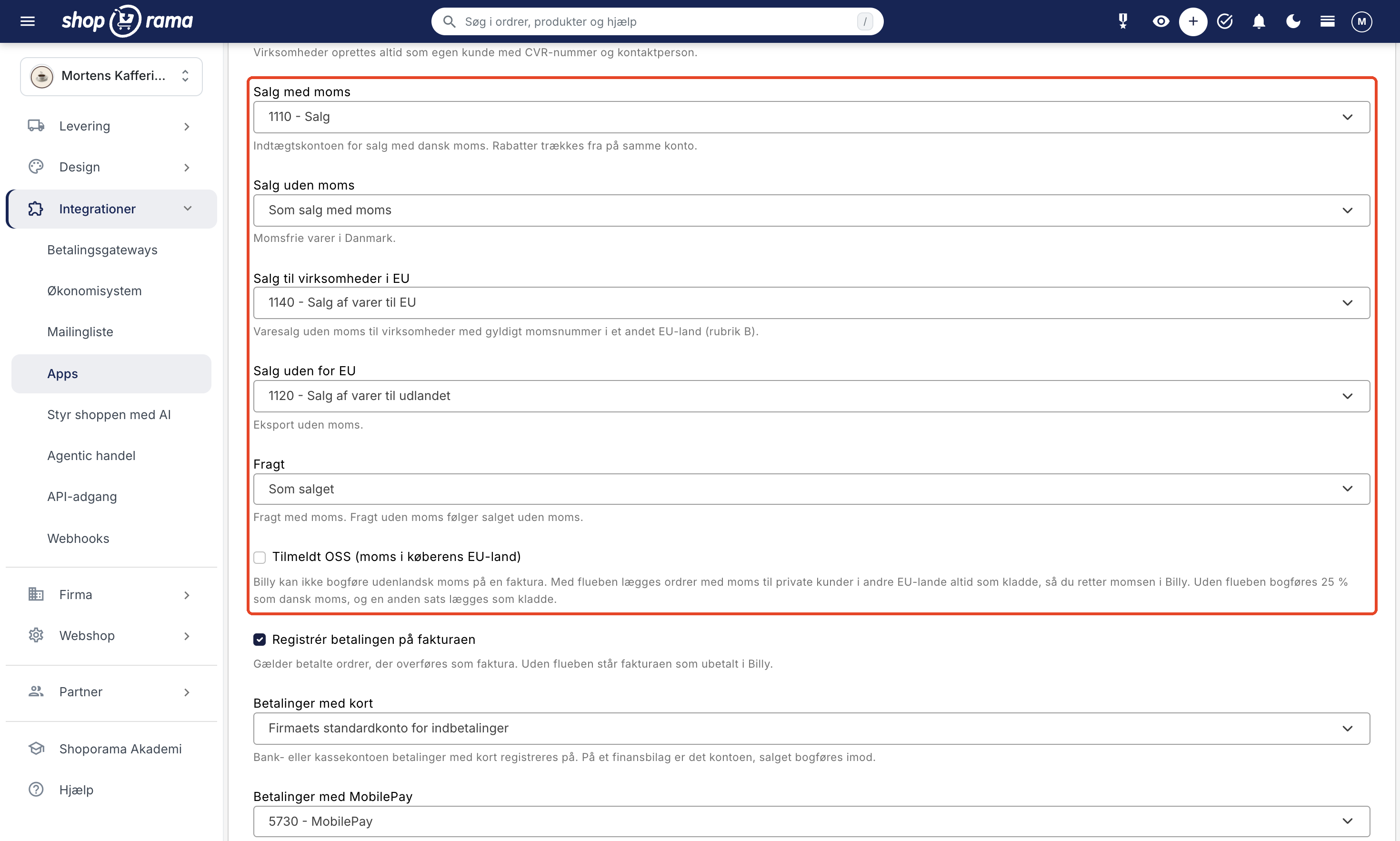
- Sales with VAT (default 1110): sales with Danish VAT. Discounts are deducted from the same account.
- Sales without VAT (default: Same as sales with VAT): VAT-exempt goods in Denmark. See VAT Categories.
- Sales to businesses in the EU (default 1140): sales of goods without VAT to businesses with a valid VAT number in another EU country (Section B). See Reverse Charge and VIES Validation.
- Sales outside the EU (default 1120): exports without VAT.
- Shipping (default : Same as sale): shipping with VAT. Shipping without VAT follows the sale without VAT.
- Registered for OSS (VAT in the buyer’s EU country) (disabled by default): Check this box if your business is registered for OSS and charges the buyer’s country’s VAT. All orders with VAT for private customers in other EU countries will then be saved as drafts in Billy, so you can adjust the VAT there. See OSS: Sales with VAT from other EU countries.
Which account a line item is posted to is determined by the VAT on the line item, the country of delivery (your own country, another EU country, or the rest of the world), and whether the customer has provided a VAT number or EAN number. A line item with VAT is always posted to “Sales with VAT,” even when the item is shipped abroad.
In Billy, it is the item on the invoice line that determines the account. The app therefore automatically creates one item per sales account in Billy. For example, the item for account 1110 is assigned the item number WEBSHOP-1110 and the name “Webshop: Sales.” You do not need to create items for shipping and discounts yourself.
If a selected account does not exist in your company, this will be indicated in the “Connection” field; for example, “Sales outside the EU: Account 1120 does not exist in the chart of accounts in Billy.” Select another one and save. Then select the account you use for that type of sale. If you’ve just created an account in Billy, click Save in the app. The chart of accounts will then be reloaded, and you can select the new account.
Step 6: Select accounts for payments
The optionto “Record payment on the invoice” is enabled by default. This means the payment is recorded for paid orders that are transferred as invoices, and the invoice is marked as paid in Billy. If this option is unchecked, the invoice remains marked as unpaid. The payment is recorded only once, only on approved invoices, and with the invoice amount, so it matches even if Billy rounds 1 øre differently than the online store.
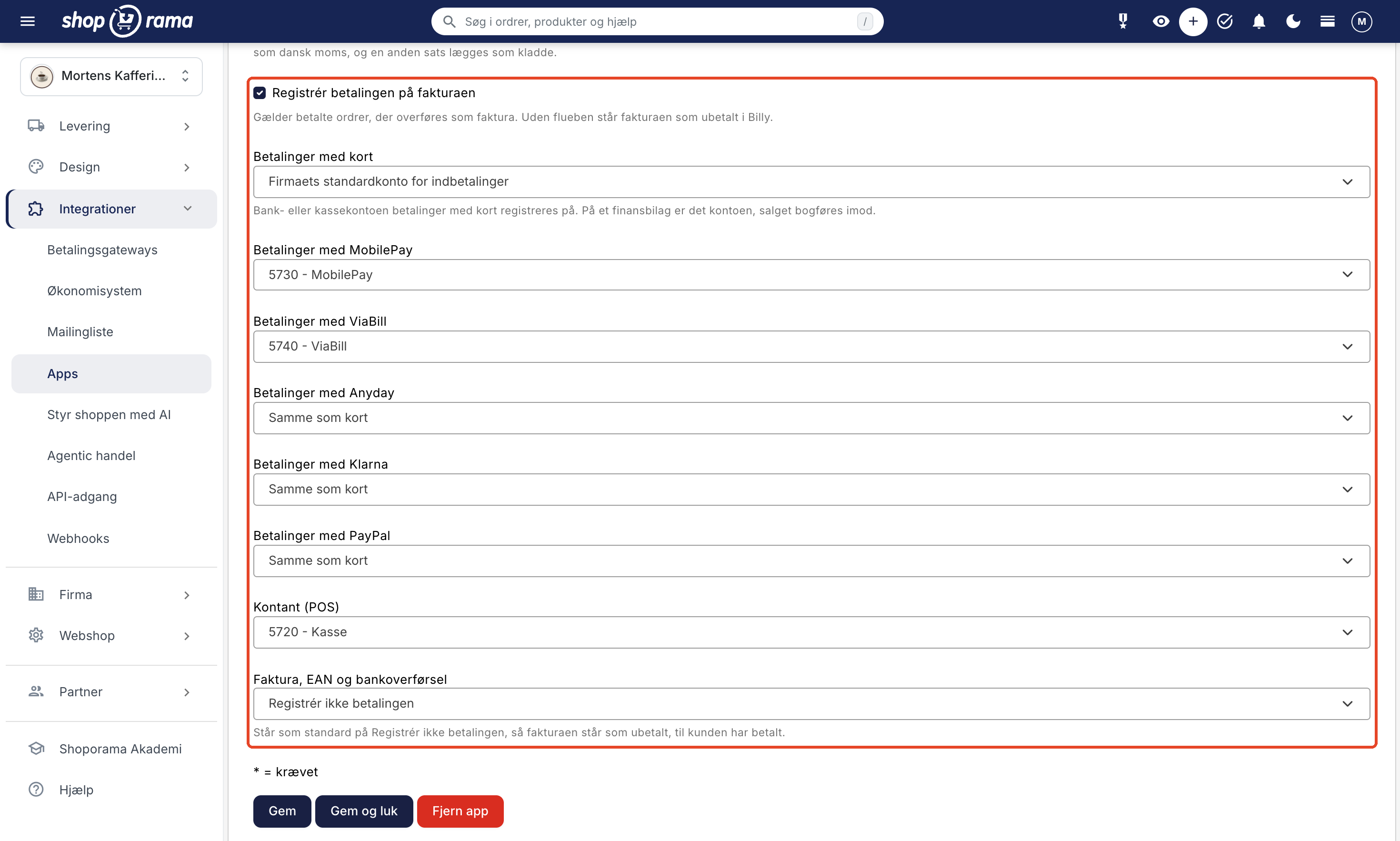
- Card payments (default: Company’s default account for incoming payments): card payments and all payment methods not covered by the other fields. The default is the account the company uses for incoming payments on invoices in Billy.
- MobilePay, ViaBill, Anyday, Klarna, and PayPal: The app recognizes them based on the payment provider, card type, and the payment method’s name in the store. Vipps falls under MobilePay. If the field is set to “Same as card,” the account associated with the card is used.
- Cash (POS): your own payment methods whose names include “cash,” such as in-store payments.
- Invoice, EAN, and bank transfer (default: “Do not record the payment”): orders with an EAN number and your own payment methods such as invoice and bank transfer. The invoice appears as unpaid in Billy until you manually record the payment when the funds are received.
Only accounts that can receive payments in Billy—such as bank and cash accounts—appear on the lists. If you set another method to “Do not record payment,” invoices using that method will also appear as unpaid. On a financial document, the payment account is the account to which the sale is posted. If the method is set to “Do not record the payment,” the financial document uses the account from the card.
Consider using one account per payment provider
The payment provider deducts its fees before the money is deposited into your bank account. If you make a sale of 249 DKK, you might only receive 241 DKK, and then the bank account in Billy won’t match your bank statement. With one account per provider—for example, one for cards and one for MobilePay—you can post the payment to the bank and the fee as an expense, so the account balances to zero. The account must be able to receive payments in Billy to be included on the list. Ask your accountant if you’re unsure how to proceed.
Click Save or Save and Close once all fields are filled out. From now on, new orders will be transferred automatically. If you’re using the old Billy integration, this will only happen once you’ve set Supplier to None, as described under Switching from the old Billy integration.
How to see what has happened to an order
The app uses three order labels:
- billy-ok (green): The order has been transferred. This also applies when it’s saved as a draft, because “Approve and Post” is automatically turned off.
- billy-failed (red): The order has not been transferred, or something went wrong along the way. The note on the order explains what happened.
- billy-pending (yellow): You set this yourself when an order needs to be transferred, for example, after an error.
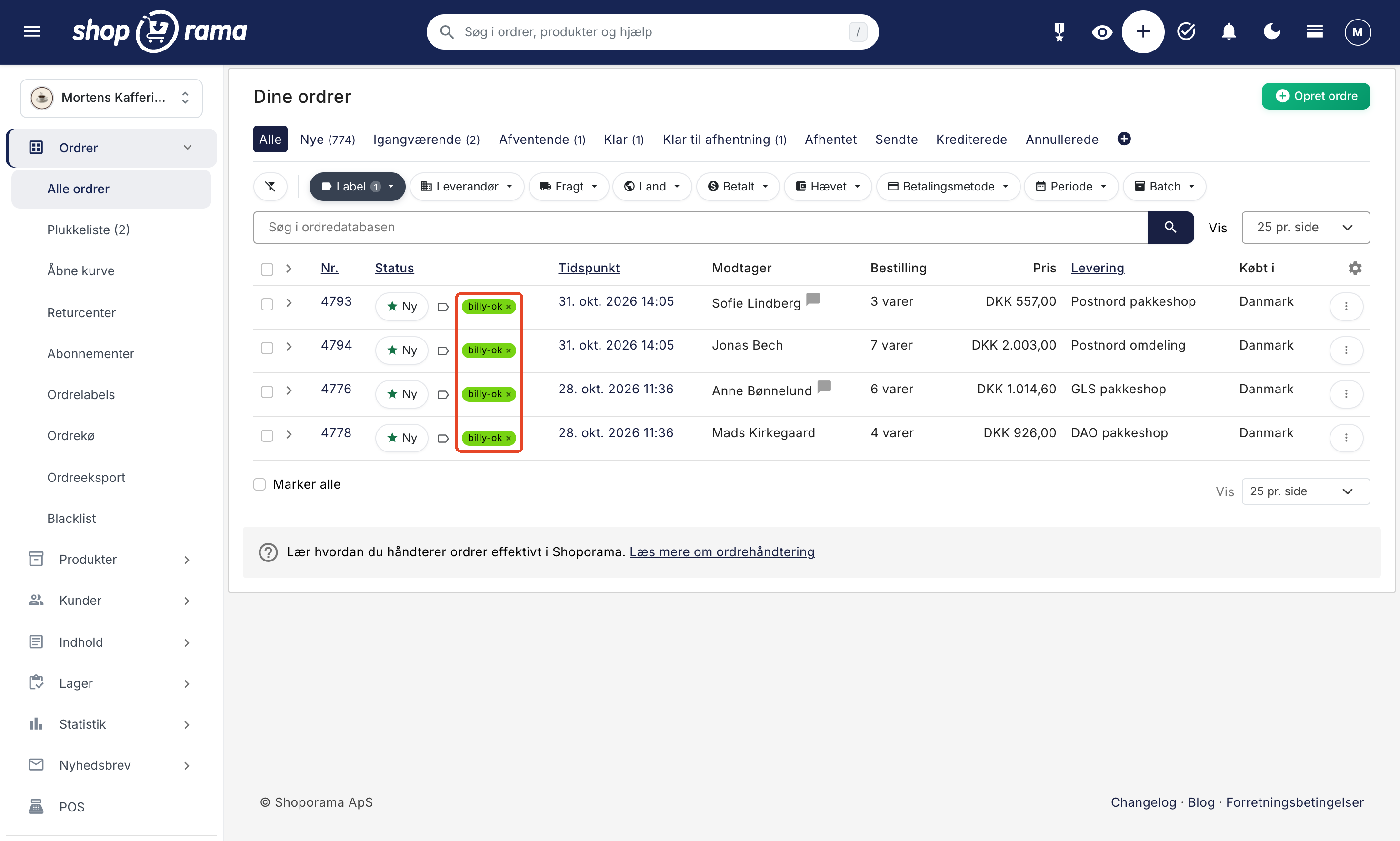
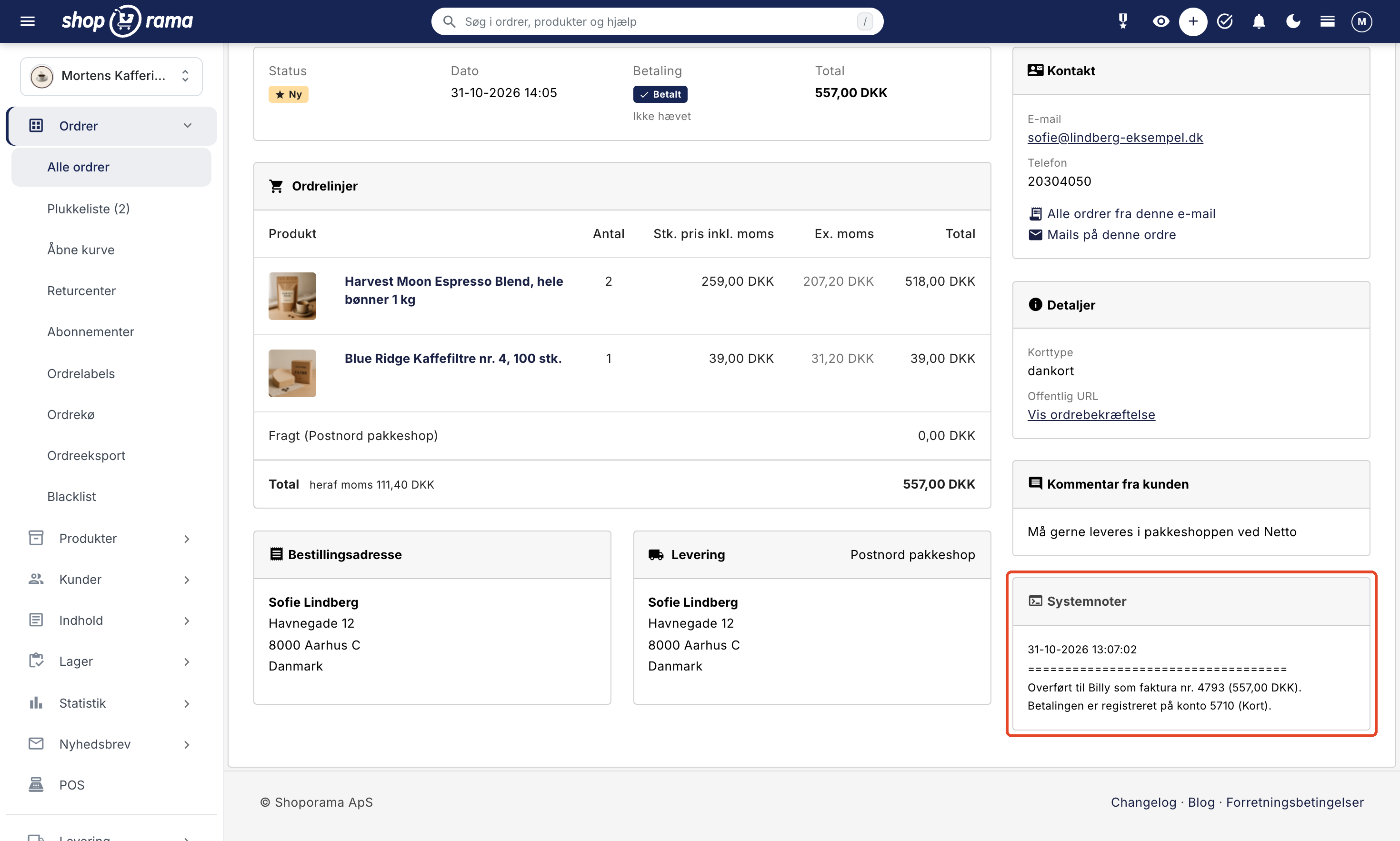
Open the order and click on System Notes to expand the note. Here you’ll find the invoice number in Billy, the amount, and whether the payment has been recorded—for example, “Transferred to Billy as invoice no. 4793 (557.00 DKK).” The payment is recorded in account 5710 (Card).
It’s transferred to Billy
The Invoice
- The invoice number consists of the prefix and the online store’s order number, e.g., 4792 or WEB-4792. If the “Cart number in invoice number ” checkbox is selected, the cart number is appended to the invoice number, e.g., WEB-4792:5402.
- The invoice date is the day the order is transferred.
- The line items show the product name with variants and the product number in parentheses, the shipping cost with the shipping method name, and the discounts listed as “Discount” with the discount code, “Promotional Discount,” and “Points Discount.” A deposit is also included.
- Amounts are shown including sales tax for individual customers, so the invoice reflects exactly what the customer paid. Businesses with a CVR or EAN number receive amounts excluding sales tax.
- At the top of the invoice are the customer’s checkout comment, “Paid with,” and the name of the payment method.
The invoice is first created as a draft, and the app compares the amounts and VAT in Billy with the order. If they match, the invoice is approved when “Approve and Post Automatically ” is enabled. If they differ, it remains as a draft, and the order is marked as “Billy-failed” with a note. See “When Something Goes Wrong.”
Customers
- The app recognizes the customer by their email address, so a returning customer isn’t added to the system again.
- Businesses are created using a CVR number (Danish) or VAT number (foreign) and an EAN number, and the contact person is listed as “Att.” on the invoice.
- If you’ve selected “Combine private customers into one customer” (Webshop customers), all orders from private customers will be assigned to the “Webshop customers” account.
- If Billy does not approve the customer’s CVR number, VAT number, EAN number, or email address, the customer will be created without that information, and this will be noted in the order.
VAT, EU, and Export
- Danish VAT (25%) is the default.
- VAT-exempt items are subject to Billy’s VAT-exempt rate.
- Sales to a business with a validVAT number in another EU country are subject to Billy’s EU sales rate (Section B).
- Exports outside the EU are subject to Billy’s export rate.
- Mixed rates on the same order are handled on a per-line basis, and discounts are allocated based on the value of the goods per rate.
OSS: Sales with VAT from other EU countries
Billy has no VAT rates for OSS and cannot post another EU country’s VAT on an invoice. An order with foreign VAT is therefore created as a draft in Billy with Danish VAT on the line items, and the order is marked as “Billy-failed” with a note to correct the VAT in Billy and approve the invoice there. Which orders this applies to depends on the checkbox “Registered for OSS (VAT in the buyer’s EU country) ” under the sales accounts:
- Checked: All orders with VAT for private customers in another EU country are saved as drafts, even when the rate is 25%, as in Sweden and Croatia. The rate alone does not indicate whether it is Danish or foreign VAT. Check the box if you are registered for OSS.
- Without the checkbox (default): Orders with a 25% rate are posted as Danish VAT. Only orders with a rate other than 25% or 0%—such as German VAT at 19%—are added as drafts.
Businesses in other EU countries that make tax-exempt purchases using a valid VAT number are not affected. Instructions on what to do with the draft entry can be found under “When Something Goes Wrong.”
Foreign Currency
An order in another country’s currency, such as euros, becomes an invoice in that currency using the exchange rate at the time of purchase, not Billy’s daily exchange rate. The exchange rate is listed at the top of the invoice, for example, 100 EUR = 746.50 DKK, along with the date of the exchange rate. The payment is recorded in Danish kroner using the same exchange rate. A financial document is always in Danish kroner, converted using the exchange rate at the time of purchase. Read more in “Sell in Multiple Countries and Languages.”
Credits and Exchanges
- A credit in Shoporama—whether created via “Create Credit Memo,” the returns center, or an exchange—becomes a credit memo in Billy. It is linked to the original invoice and assigned to the same customer. This also applies when the old Billy integration created the invoice. The app identifies it by the invoice number. Read more in “Credit Memos and Refunds.”
- The refund is posted to the credit memo in the same account if the app also posted the payment to the invoice. Otherwise, the credit memo remains open in Billy, and you settle it there.
- A financial document is credited with an offsetting financial document. Credits always follow the original order.
- For an exchange, the credit memo and the exchange order are transferred separately.
- If the original invoice is not found in Billy, the credit entry is marked as “billy-failed” with an explanation. Create the credit memo in Billy, or set the credit entry to “billy-pending.” The app will then transfer it without linking it to an invoice.
- If the original order hasn’t been transferred yet—for example, because it failed—transfer it first, and then mark the credit memo as “billy-pending.”
Canceled and Old Orders
- Canceled orders are never transferred, even if you mark them as “billy-pending.” If you cancel an order that has already been transferred, nothing happens in Billy. Instead, issue a credit memo for the order in Shoporama, and the app will create a credit memo.
- Orders from before you installed the app are only transferred if you mark them as “billy-pending.” The invoice will show today’s date, not the order’s date.
- The app never transfers the same order twice. If you mark an order that has already been transferred as “billy-pending,” you’ll instead receive a note stating that it won’t be transferred again.
- If you cancel the invoice or receipt in Billy and apply the “billy-pending” label to the order, it will be transferred again as a new one. The invoice number will then have -1, -2, and so on appended to it, because the canceled invoice retains its number.
Invoice or financial document?
Under “Transfer as,” you choose what the order will become in Billy:
- Invoice in Billy (default): Billy creates the invoice, the customer is added, and the payment can be recorded. The invoice is dated as of the transfer date and uses the order’s currency, and a credit entry becomes a credit memo linked to the invoice.
- Financial document with the online store’s invoice: Only the accounting entry is recorded in Billy. The document is added to the company’s cash book with the order’s date and the invoice number as the document number. It debits the payment method’s account and credits sales and shipping, including VAT, and Billy automatically calculates the VAT. The online store’s own invoice is attached as a PDF when “Attach online store invoice as PDF” is enabled. No customer is created, and the document is always in Danish kroner.
Select “Invoice” if you want to have customers and invoices in Billy and be able to see what has been paid. Select “Financial Document” if you only need the bookkeeping, and the online store’s invoice should be the document. Without “Approve and Post Automatically,” the financial document is added as a draft in the cash book, and the note on the order states that the document must be posted in Billy. If you change your selection, the new setting applies to orders transferred thereafter. Credit memos still follow the original order.
Switching from the old Billy integration
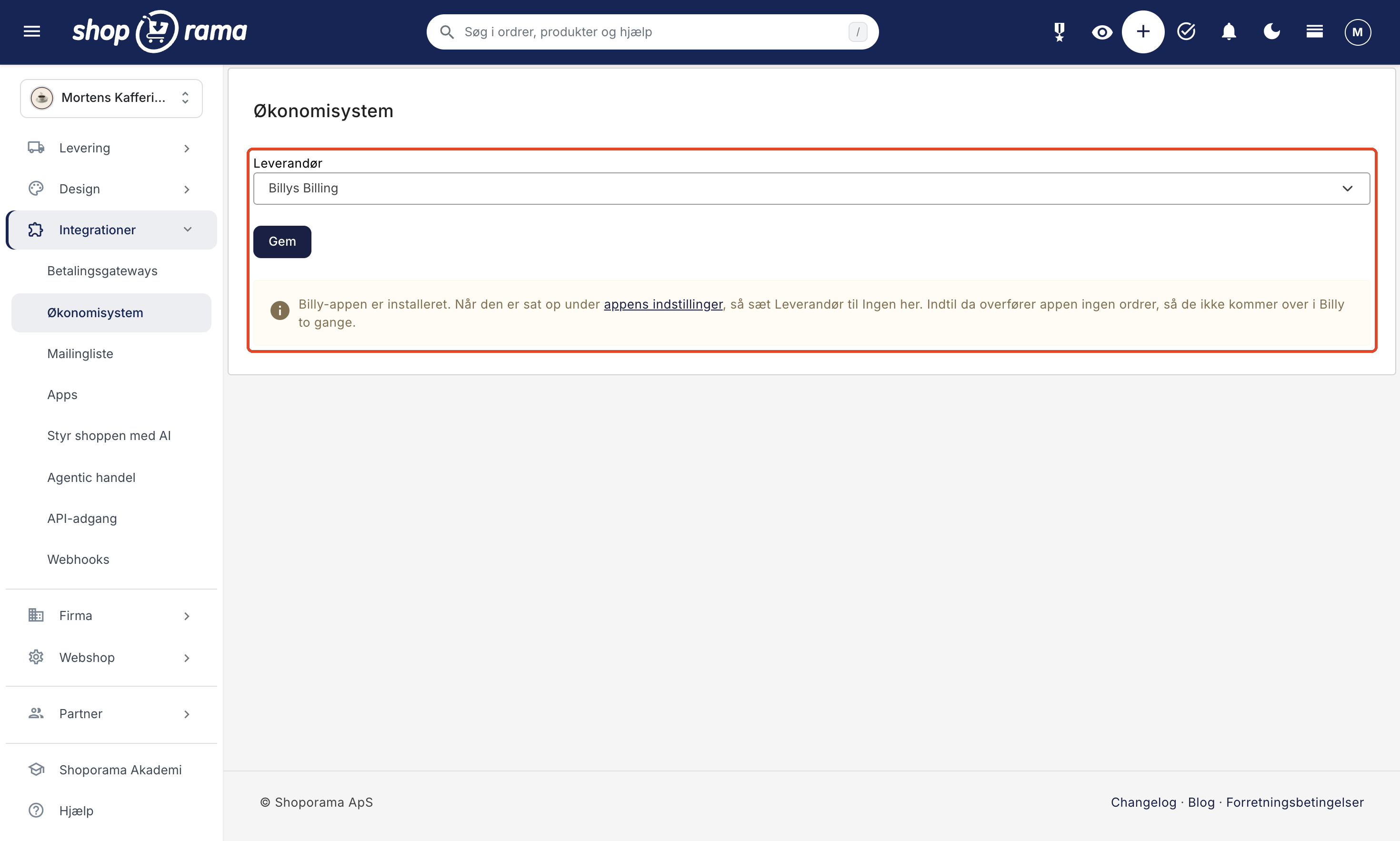
If you’ve set up Billy under Integrations → Accounting System with “Vendor” set to Billy’s Billing, it will still work, but that integration will no longer be developed. The page displays a yellow message stating that you must use the Billy app going forward. Once the app is installed, the message will instead remind you to set “Vendor” to “None” after the app is set up. We recommend that you make the switch. Here’s what you’ll get out of it:
- Credit memos are linked to the invoice and assigned to the same customer.
- Errors are displayed on the order with a label and a note, so you can see which orders are missing in Billy and why.
- One account per payment method, so that, for example, cards, MobilePay, and Klarna are kept separate.
- Customers are reused. The old integration created a new customer for each order.
- No need to create shipping or discounted items. The app automatically creates the items it needs in Billy.
- Financial documents with the online store’s invoice as a PDF, if you only need them for bookkeeping.
- OSS orders are saved as drafts so you can correct the sales tax before they’re posted.
How to Switch
- Install the app, enter the token, select accounts, and click Save, as described in steps 1 through 6 above. The settings from the old integration are not carried over, so select accounts within the app. You can use the same key as in the API Key field in the old integration or create a new token. If you leave the Invoice Number Prefix field blank, the app will use the prefix from the old integration, so the invoice numbers will continue as before. If you had the “Add basket_id to the order ” checkbox selected in the invoiceNo field of the old integration, be sure to also check the “ Include basket number in the invoice number” box so that the basket number continues to appear on the invoices.
- Go to Integrations → Accounting System, set “Vendor” to “None,” and click “Save.” From now on, the app will transfer new orders. Once you’ve saved, you won’t be able to select Billys Billing again. Therefore, first check that the “Connection” field in the app shows the company and that the only message is the one about the old integration.
- Filter the order list for the label “billy-failed” using the Label filter. Orders from the period when both were enabled have a note about the old integration. The old integration usually transferred those. If one of them is missing in Billy, apply the “billy-pending” label to it, as described under “When Something Goes Wrong.” You can remove the label from the rest.
Make the switch in one go
As long as “Supplier” is listed on Billy’s Billing, the app won’t transfer any orders. The old integration will transfer them as before, and the orders will be labeled “billy-failed” with a note stating that the app hasn’t transferred them. The app won’t transfer those orders later on its own either, so they won’t be duplicated. If you set “billy-pending” on an order that the old integration has already transferred, the app recognizes the invoice by its invoice number and amount, even when the old integration placed the cart number after the invoice number, e.g., 4792:5402. The invoice will not be created again, and the order will receive a “Billy-OK” status. If you’ve given the app a different prefix than the old integration, the app may not always recognize the invoice, so check the order in Billy first.
Once you’ve made the switch, the “Billy” item will disappear from the “Finance” menu in the order list. When you edit an order, the checkbox “Order must be sent to accounting or POS system ” will also be gone. Use the label “billy-pending” instead. Credit memos for orders transferred by the old integration are also linked to the original invoice in Billy.
When Something Goes Wrong
If a transfer fails, the order is labeled “billy-failed” and a note is added under “System Notes” with an explanation. The app does not retry automatically. Here’s how to resend the order:
- Read the note on the order and correct the error in the app or in Billy.
- Go to the order list, click the label icon “Assign/Remove Labels ” next to the order, and select “billy-pending.”
- Shortly afterward, the label will change to “billy-ok.” If it fails again, the order will be labeled “billy-failed ” and a new note will be added.
The “Connection” field in the app also keeps track of this. It counts the orders that failed in the last 7 days and shows, for example, if a selected account doesn’t exist or if the old integration under “Financial System” is still enabled.
Connection to Billy is interrupted
If “Connection to Billy is disconnected” appears in the “Connection” field, Billy has rejected the token—for example, because it was deleted in Billy or because it wasn’t copied completely. The app won’t call Billy again until you’ve entered a new token. Create a new token in Billy, enter it in the API token field, and click Save. Then set the status to “billy-pending” for the orders that were marked as “billy-failed” in the meantime. Remember that the API is only available on the Plus and Complete plans.
If it says “Billy did not respond,” the app was unable to retrieve the company from Billy, and Billy’s explanation is provided below. If it says “The company is locked in Billy,” orders cannot be transferred until the company is unlocked again in Billy.
An account does not exist or cannot be used
The note on the order says, for example , “Account 1120 does not exist in the chart of accounts in Billy.” Select a different account in the app and save. The “Connection” field also indicates if a payment account cannot receive payments in Billy, or if a sales account is not a sales account. Select a different account in the app, click “Save,” and mark the order as “Billy-pending.”
The customer was created without a CVR number or email address
If Billy does not approve the customer’s CVR number, VAT number, EAN number, or email address, the customer is created without it, and the order is processed as usual. The note will say, for example , “The customer was created in Billy without CVR number 12345678 because Billy did not approve it.” Correct the customer’s information in Billy if the number is correct. If the customer cannot be created at all, the order will be marked “billy-failed” with Billy’s explanation.
The invoice number already exists
The note says, for example, “Invoice number 4792 is already in use by another invoice in Billy.” This typically happens when you also create invoices directly in Billy. Add a prefix in the “Invoice Number Prefix” field, click “Save,” and set the order status to “billy-pending.” The prefix applies to all invoices the app creates thereafter.
If the number already exists with the same amount—for example, because the old integration created the invoice—it will not be created again. This also applies when the old integration placed the cart number after the invoice number, e.g., 4792:5402. The order will be marked as “billy-ok” and include a note stating that the invoice already existed.
The invoice is saved as a draft because the amount differs
If the amount or the sales tax in Billy differs from the order, the invoice remains as a draft, and the note states, for example , “Invoice No. 4792 is a draft in Billy because the amount differs for both amounts .” You have two options:
- Correct the draft in Billy so that the amount is correct, and set the order to “billy-pending.” The app will check the invoice again, approve it, and record the payment when “Approve and Post Automatically ” is enabled.
- Correct the settings in the app, delete the draft in Billy, and set the order to “billy-pending.” The app will then generate a new invoice.
The order includes foreign VAT (OSS)
The note states that the invoice is saved as a draft because the order includes foreign VAT (OSS), which Billy cannot post to an invoice, and that the line items have been assigned Danish VAT. Correct the VAT on the draft in Billy and approve it there. Then mark the order as “Billy-pending.” The app will then record the payment, and the order will be marked as “Billy-ok.” A financial document with foreign VAT is added to the cash book in the same way as a draft, and you post it yourself in Billy.
If orders with 25% VAT for private customers in, for example, Sweden are added as a draft, the “Registered for OSS (VAT in the buyer’s EU country) ” checkbox is selected. Uncheck it if you are not registered for OSS and charge Danish VAT.
No API token has been entered
If an order is paid before you’ve entered the token, it will be marked as “billy-failed” with a note to that effect. Once the token is saved, the order will be transferred at the next status change or when you set it to “billy-pending.”
The app does not do the following
- It does not sync products or inventory with Billy. It only sends orders and credits.
- It does not retrieve any data from Billy. If you record a payment or correct an invoice in Billy, it will not be visible in Shoporama.
- Does not reconcile payments and fees from payment providers. You do this yourself, as described under “Payment Accounts” above.
- Does not post OSS VAT. Orders with VAT from another EU country are saved as drafts.
- Does not record payments on draft orders. If you approve an invoice yourself in Billy, you must also record the payment there.
Frequently Asked Questions
Do my customers receive an email from Billy when the order is processed?
No. The app does not send any emails, and the invoice in Billy is not sent to the customer. The customer will receive the same emails from the online store as before.
What date do the invoice and payment receive in Billy?
Invoices and credit memos are dated the day they are transferred, and the payment is recorded with the same date. Financial documents are dated according to the order date. If you transfer an older order marked as “Billy-pending,” consult your accountant if it falls within a VAT period that has already closed.
Will the customers I already have in Billy be used?
No. The app only recognizes customers it has created itself. The first time a customer makes a purchase after you’ve installed the app, the customer is created in Billy, even if there’s already a customer with the same name or email address. After that, the same customer record is used every time.
My accountant will be able to see the order number on the payments in Billy. Is that possible?
Not on the payment itself, because Billy’s payments don’t have space for text. Instead, use the invoice number, which contains the online store’s order number.
The bank statement shows a different number than the invoice in Billy. How do I reconcile this?
If you keep the cart open until the order is paid, the order doesn’t exist yet when the payment is created. The payment provider therefore receives the cart number, and that’s typically what you see on the bank statement. An exchange order is paid against an order that already exists, so in that case, it’s typically the order number. Check the “Cart Number” box in the invoice number field, and both numbers will appear on new invoices, e.g., 4792:5402. Invoices that are already in Billy retain their original numbers. For those, you can search for the cart number in the order list in Shoporama to find the order there.
We have multiple online stores under the same company in Billy. What should we be aware of?
Give each shop its own prefix for the invoice number, such as “A-” and “B-.” Otherwise, two shops with the same order number could end up with the same invoice number, causing the transfer to fail. The shops can use the same API token. Each online store creates its own customers, so a customer who shops at two of the stores will appear twice in Billy.
We sell to municipalities with EAN numbers. Will the invoice be marked as paid?
No. The customer is created in Billy using the EAN number, and EAN orders fall under Invoice, EAN, and Bank Transfer, which is marked as “Do not register the payment.” The invoice remains unpaid until you mark the payment as paid in Billy. You send the invoice to the municipality yourself from Billy, so the order must be transferred immediately. If “Transfer the order” is set to “When the order is paid,” check the box next to “Automatically mark new orders as paid?” for your EAN payment method, or apply the “billy-pending” label to the order.
The customer has corrected their address after the order was transferred. Will the invoice in Billy be corrected?
No. The app transfers an order once and does not update the invoice afterward. Update the customer or the invoice in Billy. An approved invoice can only be canceled in Billy. If you do so, you can apply the “billy-pending” label to the order, and it will be transferred again as a new invoice.
I’ve created a new API token. Will customers and products be recreated in Billy?
Not if the token belongs to the same company. The app will find its customers and products again in Billy. If the new token belongs to a different company, they’ll be created there the first time they’re used. Orders that have already been transferred won’t be transferred again.
What happens if I remove the app?
No more orders will be transferred, and the API token and settings will be deleted in Shoporama. Invoices and receipts in Billy will remain, as will labels and notes on the orders. If you reinstall the app, you’ll need to enter the token and select the settings again. The app remembers which orders it has transferred so they aren’t transferred twice.
Learn more
- Accounting software you can use with Shoporama
- Order labels
- Credit notes and refunds
- Countries and currencies
- OSS (One Stop Shop) in the dictionary
Need help with the Billy app? Email us at support@shoporama.dk.
Related articles
Age verification on products
Here's how to set an age restriction of 15, 16, or 18 for products in Shoporama so that the customer's age is verified when paying with ePay....
Protect your webshop from spam orders
Guide to protecting your Shoporama webshop from spam orders and fraud using blacklist, captcha and 3D Secure.
Export orders as CSV
Guide to exporting order data as CSV from Shoporama, with the option to filter by order number or date range.
Credit notes and refunds
Complete guide to credit notes and refunds in Shoporama, including partial refunds, full credit notes and transfer to accounting systems.
Countries and Currency: Delivery Countries, Sales Tax, and Shipping
Set up delivery countries under Delivery → Countries with VAT rates, VAT zones, shipping options, and free shipping, and see how they relate to...
VAT Categories: The Correct VAT Rates for Books, Food, and Other Goods
Here's how to apply the correct VAT rate to books, newspapers, food, and other items in each country using VAT categories, and how to allocate...
Create EAN payment as a payment method
Guide to setting up EAN payment (invoice payment for businesses) on your Shoporama online store.
Set up Dinero integration
Here's how to install and connect the free Dinero app, select accounts, VAT, and payment accounts, and have your online store's orders imported as...
Set up E-conomic integration
Step-by-step guide to install Shoporama's e-conomic app from the App Store and set up automatic transfer of orders.
Set Up Uniconta Integration
Here's how to install the Uniconta app, create a user in Uniconta, and have orders from your online store transferred as sales orders, including...
Order labels
Guide to order labels in Shoporama. Create color-coded labels to organize and categorize your orders and set up automatic allocation based on...
Reverse charge og VIES-validering: sælg uden moms til erhverv i EU
Sell in multiple countries and in multiple languages
Here's how to sell in other countries in your customers' languages and currencies using "Countries": Add a country, set up the address, language,...
Related features
Billy Integration
Shoporama's Billy app transfers orders as invoices or financial documents, links credit memos to the invoice, records payments, and displays errors...
New free Billy app replaces the built-in integration
Shoporama's new, free Billy app replaces the old integration: customer data is reused, credit memos are linked to the invoice, and each payment...
Accounting programs
Automatically transfer orders from your online store to e-conomic, Dinero, Uniconta, Billy, or Business Central. Free apps for sales tax,...
Online Store with Billy (Shine Accounting)
Connect your online store to Billy (Shine Accounting) using Shoporama's free app. Orders are converted into invoices or financial documents, and...
Billy
Billy, now known as Shine Regnskab, is a Danish accounting program for small businesses. Find out what it's used for and how orders from your...