Mailing List Integration: Connect Shoporama to Your Newsletter Provider
Automatically forward newsletter sign-up notifications from your online store to Klaviyo, Ubivox, Mailchimp, Campaign Monitor, or Brevo, and see when it’s better to use Shoporama’s own module.
If you already have a newsletter system, Shoporama can send your subscriptions directly to it. When a customer checks the "Subscribe to newsletter" box in your store, their email address is added to the list you’ve chosen within a moment. You won’t have to manually export and import lists, and you’ll avoid the duplicate entries and spelling errors that come with it.
Where can you find the setup?
The page is located in the admin panel under Store, Integrations, Mailing List. It consists of a single form with the “Provider” field at the top, followed by the fields specific to the provider you select. Click the Save button to save your changes. If you select “None”—which is the default—subscriptions won’t be forwarded anywhere.
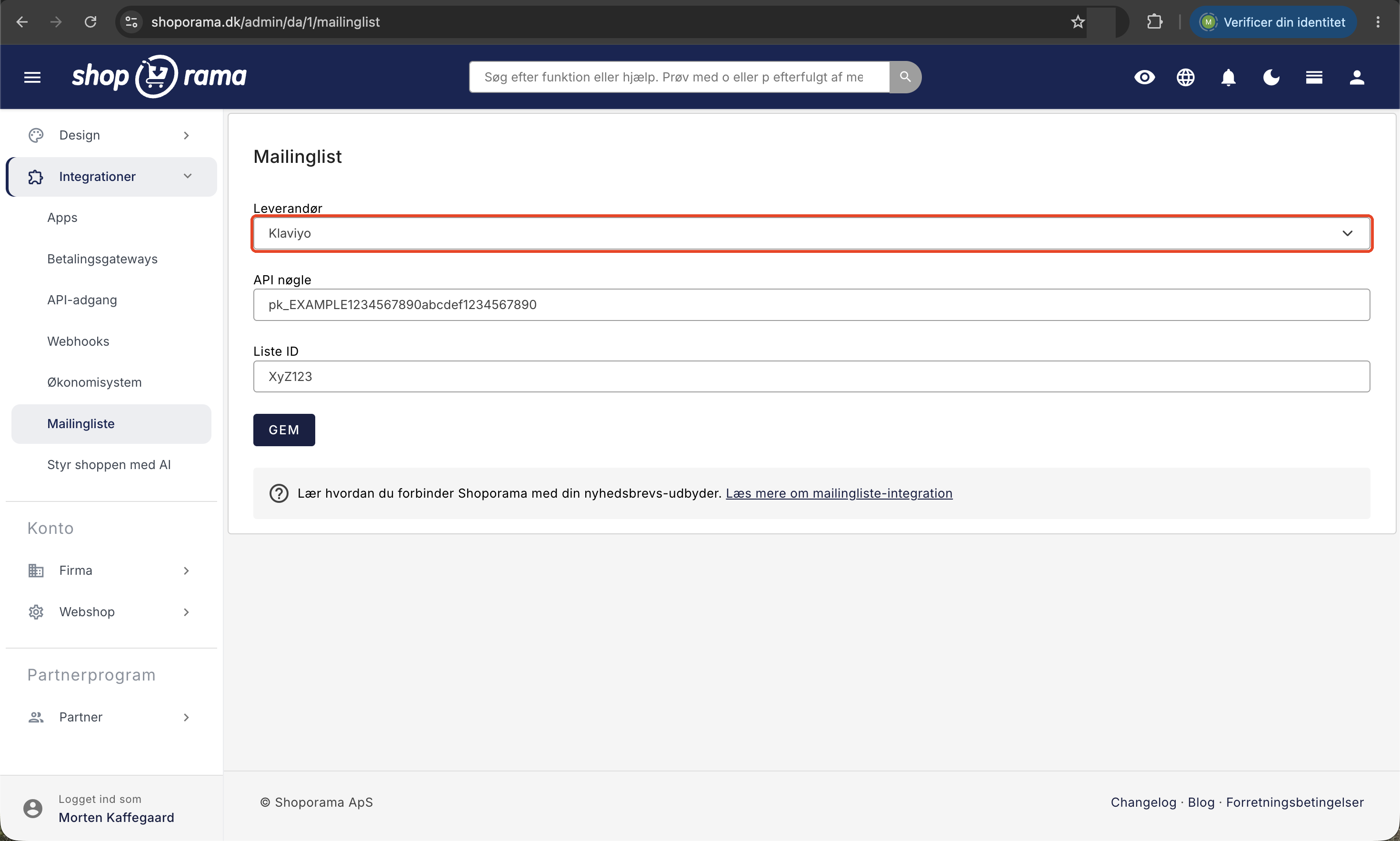
Which providers can Shoporama send orders to?
In the “Provider” field, you can choose from five services:
- Klaviyo
- Ubivox
- Mailchimp
- Campaign Monitor
- Brevo
There are no other options on this page. HeyLoyalty, for example, is set up as an app under Store, Integrations, Apps—it’s not something you select here. If you use a service that’s neither on the list nor available as an app, your developer can set up the connection via webhooks or the REST API.
What gets sent, and when?
Shoporama forwards a subscription request when the customer actively opts in. This happens in three places, provided your theme includes the following fields: at checkout, where checking the box triggers the sign-up when the order is created; from a sign-up form in the theme, typically in the footer; and from the “notify me when this item is back in stock” form, if the customer also checks the newsletter box.
The information sent is the customer’s email address and name. Klaviyo, Mailchimp, and Brevo receive the name split into first and last name, while Campaign Monitor receives it as a single name. Ubivox receives only the email address and list selection. The data is sent via a background queue, so the customer never has to wait for your provider. However, it may take a moment for the contact to appear. This is completely normal.
Setup for Each Provider
Klaviyo
Klaviyo is the most comprehensive integration because it can both sign up customers and send events from the store. You’ll need to enter the Public Key and Private Key, both of which can be found in your Klaviyo account under API Keys. The page links directly to that section. Once the keys are saved, Shoporama retrieves your lists so you can select the correct one in the “Sign up your customers for this list” field.
In addition, there are three checkboxes:
- "Automatically insert tracking code into your theme" adds Klaviyo’s tracking script to your pages and tells Klaviyo who the visitor is if the store knows their email address. The help text warns that you shouldn’t enable this if Klaviyo is already built into your theme, as is the case with the Alaska theme, for example. Otherwise, you’ll end up with the code twice.
- "Use events" allows Shoporama to send events to Klaviyo so you can build automated flows based on them.
- "Respect double opt-in" doesn’t actually change what we send to Klaviyo. If your Klaviyo recipients need to confirm their subscription, you set that up in the list within Klaviyo.
With events enabled, Shoporama sends “Added to Cart” when an item is added to the cart, “Placed Order” and “Ordered Product” per line item when the order is created, “Paid” upon payment, “Status: ...” upon status changes, as well as “Add label: ...” and “Remove label: ...” when you apply or remove labels. The events contain the order’s data, including line items with price, quantity, SKU, image, category, and brand, as well as both shipping and billing addresses; and if you use the loyalty program, the customer’s points balance is included. Events are only sent when there is an email address to associate them with. See also Set Up Klaviyo Integration. If we can’t retrieve your lists, the page displays a red error box with a message from Klaviyo—this is almost always due to an incorrect or expired private key.
Brevo
For Brevo, enter your API key, and the page will link to where you can find it. Once the key is saved, Shoporama will import your Brevo lists into the “List” field. Checking the “Respect double opt-in” box ensures that Brevo sends a confirmation email, and the contact is added to the list only after the customer has clicked the link. In the “Redirect URL for opt-in” field, you can specify where the customer should be redirected afterward. If the field is left blank, the customer will be redirected to your homepage.
Two things typically cause issues. The “Template ID for opt-in” drop-down list only shows the templates in Brevo that have been tagged with “optin”; if none of them have this tag, you’ll see a yellow warning instead. Also, the template must contain Brevo’s confirmation link {{ params.DOIurl }}; otherwise, the customer won’t have anything to click on. The page shows screenshots of how to add the tag.
Note that both the list and the opt-in template must be selected before Shoporama sends anything to Brevo. If either is missing, the sign-up process stops, and you’ll receive a notification in the admin panel. If double opt-in is disabled, the contact is added directly to the list, and existing contacts have their name and list membership updated. Read more in the article about the Brevo integration.
Mailchimp
For Mailchimp, enter the API key and List ID—the list ID is what Mailchimp calls the Audience ID. A common mistake is entering a key without the data center: Mailchimp keys end with a code such as -us19, and if you only copy the first part, we won’t be able to find your account. You’ll then receive a notification that the data center is missing. Always copy the entire key.
The first time, you’ll need to enter the list ID manually. Once both the key and the ID are saved, Shoporama will fetch your audiences, and the field will become a drop-down list going forward. Contacts are created with first and last names in the FNAME and LNAME fields, and existing contacts are updated rather than recreated.
Campaign Monitor
Here, you enter the API key and List ID. Additionally, Campaign Monitor has a “Custom Fields” section where you can transfer purchase information to the contact. Enter the field’s name as it appears in Campaign Monitor and select a value: Amount, Product, Purchase Date, Number of Purchases, or Supplier. The “Add Field” button provides more options. The values can only be populated when the sign-up is associated with an order; if someone signs up from the footer, there are no data points to retrieve.
Ubivox
For Ubivox, enter the Username, API Password, and API URL. Checking the “Send sign-up confirmation ” box instructs Ubivox to send a confirmation email to the customer. When you save, Shoporama retrieves both your goals and your email lists, so the “Goal” and “List” fields become drop-down lists. If you don’t have a goal with “shoporama” in the name, one named Shoporama is automatically created.
External provider or Shoporama’s own newsletter module?
This is the most important choice on this page, and it’s an either/or decision. Shoporama also has its own newsletter module under “Newsletter” in the menu. On the “Newsletter” > “Setup” page , you’ll find the checkbox labeled “Use internal newsletter list.”
As long as this checkbox is selected, all newsletter sign-ups will go to Shoporama’s own list, and not to the provider you’ve selected on the mailing list page. If you want to collect subscribers in Klaviyo, Mailchimp, Brevo, Campaign Monitor, or Ubivox, “Use internal newsletter list” must be turned off.
Choose an external provider when:
- You already have flows, automations, or templates set up and don’t want to rebuild them from scratch.
- You’re sending emails for multiple stores or channels and want to keep your subscribers in one place.
- You need advanced segmentation or flows that respond to behavior. With Klaviyo and events enabled, you can feed store data directly into these types of flows.
- Your agency is already working in a specific system.
Choose Shoporama’s own newsletter module when:
- You want everything in one place and want to avoid yet another subscription and yet another login.
- You want to pull products, prices, and images directly into the newsletter from your own store.
- You need the sign-up pop-up, lists, segments, or a public newsletter archive. The pop-up only works with the internal module.
- You send relatively few emails and prefer to pay based on usage rather than a fixed monthly subscription.
Read more in the article about the Newsletter Module.
Consent and Documentation
Regardless of which provider you use, Shoporama stores proof of every single subscription: email address, IP address, browser, the page from which the subscription originated, and the time. This is exactly the documentation you’ll need to provide if someone disputes having subscribed. You can download the list as a CSV file under Customers, Downloads by clicking the “Download Newsletter Subscriptions” button.
When Something Doesn’t Work
Because sign-ups are processed in the background, Shoporama cannot display an error on the screen immediately. Instead, the messages appear under “Notifications” on the bell icon at the top of the admin panel. Here you’ll find the error message from the provider, such as an incorrect key or a missing list ID. Always check there first, and then go through the checklist:
- Is “Use internal newsletter list” turned off under Newsletter, Setup?
- Have you selected a provider, and have both the key and the list been saved?
- Does your theme even have a checkbox for the newsletter in the checkout or a sign-up form?
- For Brevo: Have you selected both a list and an opt-in template with the “optin” tag?
For those with technical expertise
The sign-up field in the theme is called “mailinglist” and is sent along with the email. In the checkout, the checkbox remains selected until the order is created. On the stock notification form, both “mailinglist” and “newsletter” are accepted as field names. Built-in themes such as Delaware, Alaska2, and Montana already have these fields, while custom-built themes need to have them added.
Each subscription also triggers the `newsletter_subscribe` event, regardless of whether you use the internal module or an external provider. This is the event that apps like HeyLoyalty listen for, and it can be forwarded to your own webhooks. Klaviyo events are managed independently via “Use Events” and continue to be sent even if recipients are collected internally. If you use Mailchimp, the ` mailing_list_ids` field is also available on the product: if a customer purchases a product with list IDs in that field and has opted in to the newsletter, the customer is also subscribed to those lists. This field is set via product import, product export, or the REST API.
Frequently Asked Questions
Can I use both Mailchimp and Shoporama’s own newsletter at the same time?
No, not for regular sign-ups. As long as “Use internal newsletter list” is enabled, all sign-ups go to Shoporama’s own list, and the external provider receives nothing. Choose one place to collect your subscribers; otherwise, you’ll end up with half a list in each place.
Why doesn’t my test subscription appear in Klaviyo right away?
Subscriptions are sent in a background queue, so it typically takes a moment. If it doesn’t show up at all, check that a list is selected, that the private key is saved, and whether there’s an error listed under Notifications. Also, remember to make sure the checkbox in the shop is selected.
A customer calls and wants to sign up. Can I do that for her?
Not from the mailing list page. It only forwards sign-ups when they come from the shop. If you need to add a contact manually, you’ll need to do so through your provider. If you’re using Shoporama’s own newsletter module instead, you can create recipients directly under “Newsletter,” “Recipients.”
Where is the “subscribe to newsletter” checkbox in my shop?
It’s located in your theme, typically on the address step in the checkout and often also as a form in the footer. The built-in themes already have it. If you have a custom-built theme, it won’t appear automatically, and your developer will need to add the field.
Can I provide proof to my accountant or the Data Protection Authority that the customer has given consent?
Yes. Shoporama stores the email address, IP address, browser, the page from which the subscription originated, and the time of every single subscription, regardless of which provider you use. You can download this as a CSV file under Customers, Downloads using the “Download Newsletter Subscriptions” button.
Does the customer receive a confirmation email, i.e., a double opt-in?
On the mailing list page, you can enable confirmation for Brevo, where it says “Respect double opt-in,” and for Ubivox, where it says “Send sign-up confirmation.” With Brevo, you must also select the template. Klaviyo has a checkbox with the same wording as Brevo’s, but in practice, the confirmation is controlled by the list’s own settings within Klaviyo. The same applies to Mailchimp and Campaign Monitor.
I’m switching providers. Will my existing subscribers be transferred?
No. We only forward new sign-ups from the moment you’ve saved the new setup. Existing subscribers must be exported from the old provider and imported into the new one. If you need a list of those who signed up through the store, the CSV file is located under Customers, Downloads.
Can I transfer order data so I can create flows based on what people have purchased?
Yes, with Klaviyo. If you enable “Use events,” we’ll send events for items added to the cart, orders created, each line item, payments, status changes, and labels—including prices, SKUs, categories, and addresses. Campaign Monitor can retrieve individual values as custom fields. For everything else, you’ll need to use webhooks or the REST API.
Does the sign-up pop-up work with Mailchimp or Klaviyo?
No. The pop-up under “Newsletter” > “Sign-up Form” is part of Shoporama’s own newsletter module and requires that “Use internal newsletter list” be enabled. With an external provider, you can either use the provider’s own pop-up or have a form created within the theme.
We use HeyLoyalty. Why isn’t it on the list of providers?
HeyLoyalty is designed as an app instead. You install and set it up under Store, Integrations, Apps, and it listens to the same newsletter sign-ups as the rest of the system. So you don’t need to select anything on the mailing list page.
Related articles
Set up Klaviyo integration
Guide to setting up Klaviyo integration with your Shoporama online store for automated email flows.
Brevo integration newsletter signup integration from your webshop
How to connect your Shoporama webshop to Brevo (formerly Sendinblue) so that new newsletter subscriptions automatically land in Brevo. Read what...
The newsletter module
Complete guide to Shoporama's built-in newsletter module. Learn how to create campaigns, segment recipients, use A/B testing, set up automatic...
Stock notification: Notify your customers when items are back in stock
Learn how to set up email notifications so your customers can be notified when out-of-stock products are restocked in your Shoporama online store.
Unsubscribe links in automatic emails
Give your customers the option to unsubscribe from automatic follow-up emails after purchases and product reviews - with a simple link in the email.
GDPR - Data Processing Agreement
Information about data processing agreement with Shoporama according to GDPR.
Webhooks in Shoporama
Complete guide to webhooks in Shoporama. Get automatically notified on a URL when something happens in your online store. List of all events,...